Have you ever checked your sign in an Indian (Vedic) chart and found it was different from your “Western” sun sign? You are not alone. This is one of the most common surprises when people compare the two systems.
Vedic astrology (Jyotish) and Western astrology both use your date, time and place of birth to create a chart. But they measure the zodiac differently, emphasise different factors and use different methods for timing events.
This guide explains the main differences between Vedic and Western astrology in simple terms.
What Is Vedic Astrology (Jyotish)?
Vedic astrology, known in Sanskrit as Jyotish (“science of light”), is the traditional astrology of India. It is rooted in ancient Indian texts and is still widely used for understanding personality, life phases, relationships and auspicious timing (muhurta).
What Is Western Astrology?
Western astrology developed from Babylonian, Greek and later European traditions. Popular Western astrology focuses strongly on the Sun sign, while modern Western astrologers also use the full birth chart, often with a psychological and self-reflective approach.
Difference 1: Sidereal vs Tropical Zodiac
This is the most important difference.
- Western astrology uses the tropical zodiac, which is tied to the seasons. 0° Aries is fixed to the spring (vernal) equinox.
- Vedic astrology uses the sidereal zodiac, which is aligned with the actual background constellations (fixed stars).
Because of a slow wobble in the Earth’s axis called precession, the two zodiacs have gradually drifted apart. Today the difference, called the ayanamsa, is about 24 degrees.
What this means for you: Many people’s Vedic signs fall one sign earlier than their Western signs. For example, the Sun enters tropical Aries around 20–21 March, but sidereal Aries around 13–14 April.
Difference 2: Moon Sign and Ascendant vs Sun Sign
- Vedic astrology places great importance on the Moon sign (rashi) and the ascendant (lagna). The Moon is seen as reflecting the mind and emotions.
- Popular Western astrology emphasises the Sun sign, which reflects identity and core self.
Difference 3: Nakshatras
Vedic astrology divides the zodiac into 27 nakshatras (lunar mansions), each about 13°20′. The Moon’s nakshatra at birth is considered highly significant for personality, compatibility and timing. Western astrology does not typically use nakshatras.
Difference 4: Planets Used
- Vedic astrology uses nine grahas: Sun, Moon, Mars, Mercury, Jupiter, Venus, Saturn and the two lunar nodes, Rahu and Ketu.
- Western astrology uses the Sun, Moon and planets including Uranus, Neptune and Pluto, and sometimes additional points such as Chiron.
Difference 5: Predictive Techniques
- Vedic astrology is known for its dasha system, especially the Vimshottari dasha, a 120-year cycle of planetary periods used to time life phases. It also uses transits (gochar) and divisional charts such as the navamsa (D9).
- Western astrology uses transits, secondary progressions and solar returns.
Difference 6: Aspects
- Vedic astrology uses drishti (planetary sight): every planet aspects the 7th house from itself, and Mars, Jupiter and Saturn have additional special aspects.
- Western astrology uses angular aspects such as conjunctions, sextiles, squares, trines and oppositions.
Difference 7: Chart Style
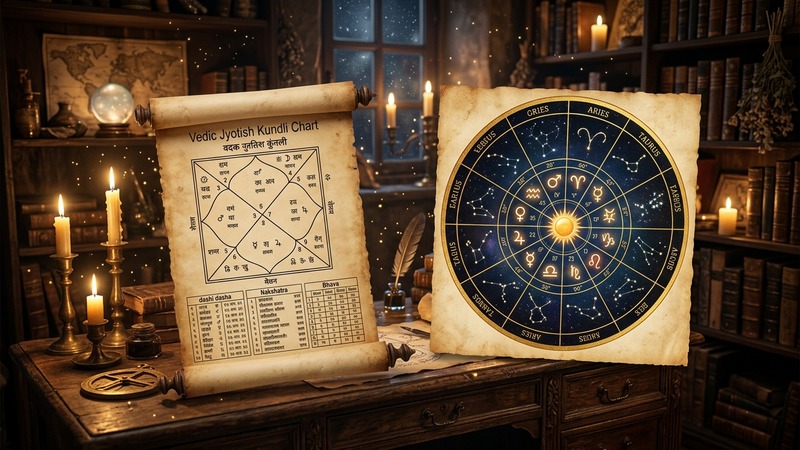
- Vedic charts are drawn as a diamond-shaped North Indian chart or a square South Indian chart.
- Western charts are usually drawn as a circular wheel.
Difference 8: Remedies and Approach
- Vedic astrology often includes remedies such as mantras, prayers, charity, fasting or gemstones, depending on the astrologer’s tradition.
- Modern Western astrology tends to focus on self-understanding and personal growth.
Vedic vs Western Astrology: Quick Comparison
| Aspect | Vedic (Jyotish) | Western |
|---|---|---|
| Zodiac |
Sidereal (fixed stars) | Tropical (seasons) |
| Main emphasis | Moon sign and ascendant | Sun sign (popularly) |
| Lunar mansions | 27 nakshatras | Not typically used |
| Planets | 9 grahas incl. Rahu and Ketu | Includes Uranus, Neptune, Pluto |
| Timing | Dashas, transits, divisional charts | Transits, progressions, solar returns |
| Aspects | Planetary drishti | Angular aspects |
| Chart shape | North or South Indian style | Circular wheel |
| Approach | Life events, timing, remedies | Psychology and self-reflection |
From Hardik’s practice: At The Golden Lotus, our consultations are rooted in classical Vedic astrology (Parashari system) using the accurate Lahiri ayanamsa. We focus on revealing your soul’s karmic blueprint, clarifying major life dashas, and providing practical, sattvic Vedic remedies (such as specific mantra sadhana and gemstone guidance) that empower you to navigate life with peace and purpose.
Book an Astrology Consultation
Discover what your Vedic chart reveals about your life phases, strengths and timing with a Vedic Astrology Consultation. For a different kind of guidance, you can also explore Tarot Card Reading.
Related Reading
- How to Charge Crystals with the Full Moon
- Browse all articles in The Golden Lotus Spiritual Journal
Frequently Asked Questions
Why is my Vedic sign different from my Western sign?
Because Vedic astrology uses the sidereal zodiac and Western astrology uses the tropical zodiac. The two are currently about 24 degrees apart.
Is Jyotish the same as Vedic astrology?
Yes. Jyotish is the Sanskrit name for Vedic astrology.
Which is more important in Vedic astrology, the Moon sign or the Sun sign?
The Moon sign and ascendant are generally considered more important than the Sun sign.
Disclaimer: Astrology is a traditional system for reflection and guidance. It is not a substitute for professional medical, mental-health, legal or financial advice, and important decisions should not be based on astrology alone.

Have Questions About This Practice?
Whether you want to learn Reiki, explore Mesmerism, or book a 1-on-1 private energy alignment session, we welcome your questions.