
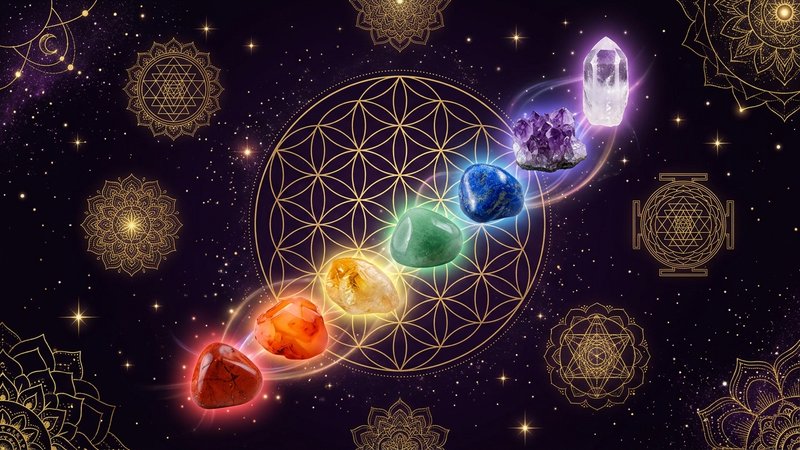
Chakra crystals are stones traditionally paired with the seven main energy centres of the body, usually matched by colour and by the qualities each centre is said to govern. Red jasper and black tourmaline belong to the root, carnelian to the sacral, amethyst and clear quartz to the crown.
This guide covers all seven chakras, the stones most commonly linked to each, a quick-reference chakra crystal chart, and the practical side of working with them: choosing, meditating, wearing, cleansing and recharging.
It also keeps one important line clear throughout. Crystals are minerals with real physical properties. The healing qualities attributed to them belong to spiritual tradition and personal practice, not to demonstrated science. Understanding that difference makes the practice more honest, not less meaningful.
What Are Chakra Crystals?
The chakra system comes from Indian yogic and tantric traditions, where chakras are described as centres of subtle energy running along the spine from the base to the crown. Each is associated with particular themes: stability at the root, creativity at the sacral, expression at the throat, awareness at the crown.
Chakra crystals are the stones matched to those centres. The pairing is mostly based on colour. Red and black stones go to the root, orange to the sacral, yellow to the solar plexus, green and pink to the heart, blue to the throat, indigo to the third eye, and violet or clear stones to the crown.
Worth knowing: the chakra system is ancient, but the crystal correspondences are comparatively modern. Most of the colour-matched lists circulating today took shape through twentieth-century Western esoteric and New Age writing rather than classical Indian texts. That does not make them useless. It does mean there is no single authoritative list, which is why different books and websites recommend different stones for the same chakra.
Spiritual Symbolism and Science: An Important Distinction
Crystals are minerals. Their composition, crystal structure, hardness and optical behaviour are measurable facts. Quartz really is piezoelectric, which is why it appears in watches and electronics.
What has not been demonstrated is that holding, wearing or placing a stone produces healing effects in the body. One frequently cited experiment found that participants reported comparable sensations whether they were given genuine quartz or an imitation, which points towards expectation and attention rather than the stone itself.
That does not mean the practice is worthless. Focus, ritual, intention and the simple act of pausing have real value in daily life. A stone in your hand can anchor attention in the same way a mala or a breath count does.
Two rules keep this grounded:
- Chakra stones are not a treatment for any medical or psychological condition.
- They are not a substitute for a doctor, a therapist or prescribed medication.
Treat them as symbolic tools within a personal practice, and the rest of this guide becomes genuinely useful.
Seven Chakra Crystal Chart
| Chakra | Colour | Common Crystals | Traditional Association |
|---|---|---|---|
| Root (Muladhara) | Red, black | Red jasper, black tourmaline, hematite, smoky quartz, garnet | Grounding, safety, stability, physical foundation |
| Sacral (Svadhisthana) | Orange | Carnelian, orange calcite, sunstone, moonstone | Creativity, emotion, pleasure, flow |
| Solar Plexus (Manipura) | Yellow | Citrine, tiger’s eye, yellow jasper, pyrite | Confidence, willpower, personal authority |
| Heart (Anahata) | Green, pink | Green aventurine, rose quartz, jade, rhodonite | Love, compassion, forgiveness, connection |
| Throat (Vishuddha) | Blue | Blue lace agate, sodalite, aquamarine, turquoise | Expression, honesty, communication |
| Third Eye (Ajna) | Indigo | Amethyst, lapis lazuli, labradorite, fluorite | Intuition, clarity, inner perception |
| Crown (Sahasrara) | Violet, white, clear | Clear quartz, amethyst, selenite, howlite | Awareness, stillness, spiritual connection |
Root Chakra Crystals
The root chakra sits at the base of the spine and is associated with security, belonging and the sense of having solid ground under you.
Common root chakra crystals:
- Red jasper: steadiness and endurance
- Black tourmaline: boundaries and protection from draining influences
- Hematite: weight, grounding, coming back into the body
- Smoky quartz: releasing what feels heavy or stuck
- Garnet: vitality and commitment
These are the stones people reach for during periods of upheaval: a move, a job change, financial uncertainty, or simply a mind that will not settle. In practice they are usually held in the hand, kept in a pocket, or placed near the base of the spine while lying down.
Sacral Chakra Crystals
The sacral chakra sits below the navel and is linked to creativity, emotional expression and enjoyment.
Common sacral chakra crystals:
- Carnelian: the classic sacral stone, associated with warmth and creative momentum
- Orange calcite: lightness and playfulness
- Sunstone: optimism and openness
- Moonstone: emotional rhythm and intuition
People tend to work with these when creativity feels blocked, when life has become purely functional, or when emotions feel flat rather than intense.
Solar Plexus Chakra Crystals
The solar plexus sits above the navel and is associated with confidence, decision-making and personal will.
Common stones:
- Citrine: the best known solar plexus stone, linked to confidence and optimism
- Tiger’s eye: courage and steady judgement
- Yellow jasper: resilience and perseverance
- Pyrite: initiative and self-belief
A note on honesty: citrine is widely sold in a deep amber shade that is usually heat-treated amethyst rather than natural citrine. Natural citrine is typically paler. Neither is more “real” spiritually, but you should know what you are buying.
Heart Chakra Crystals
The heart chakra sits at the centre of the chest and is associated with love, compassion and connection, towards others and towards yourself.
Common heart chakra crystals:
- Rose quartz: gentleness, self-compassion, affection
- Green aventurine: ease, optimism, new beginnings
- Jade: harmony and steadiness
- Rhodonite: working through hurt and resentment
- Malachite: emotional release, traditionally used with care
The heart chakra is where most people begin, because the themes are the ones they feel most immediately.
Throat Chakra Crystals
The throat chakra is associated with expression, honesty and being able to say what is true for you.
Common stones:
- Blue lace agate: calm, softened speech
- Sodalite: clarity of thought before speaking
- Aquamarine: fluency and courage in conversation
- Turquoise: traditionally worn as a protective and communicative stone
These are often chosen before difficult conversations, presentations or creative work that requires a voice.
Third Eye Chakra Crystals
The third eye sits between the eyebrows and is associated with insight, perception and inner clarity.
Common third eye crystals:
- Amethyst: stillness and reflection
- Lapis lazuli: inner truth and study
- Labradorite: intuition and imagination
- Fluorite: mental order and concentration
Third eye stones are the ones most often used in seated meditation, usually held or placed on the forehead while lying down.
Crown Chakra Crystals
The crown chakra sits at the top of the head and is associated with awareness, stillness and a sense of connection to something larger than yourself.
Common crown chakra crystals:
- Clear quartz: clarity and openness, often called an all-purpose stone
- Amethyst: the most widely used crown stone, bridging third eye and crown
- Selenite: lightness and spaciousness, traditionally used to clear a room
- Howlite: quiet and rest
Crown work is less about doing and more about settling. Most practices involving these stones are simply sitting, breathing and letting the mind become quiet.
How to Choose Chakra Stones
You do not need all seven to begin. Two questions will narrow it quickly.
What theme is most alive for you right now? Restlessness and insecurity point to the root. Creative flatness points to the sacral. Difficulty speaking up points to the throat. Start there.
Which stone do you actually respond to? Colour, weight and texture matter more than a list. If you are buying in person, hold a few and notice which one you keep returning to.
Practical checks when buying:
- Ask whether the stone is natural, dyed or heat-treated. Dyed howlite sold as turquoise is extremely common.
- Very cheap “raw” stones in bulk sets are often reconstituted or coloured glass.
- Buy a few stones you will use rather than a large set you will store in a drawer.
Cost is not a measure of spiritual value. A small piece of red jasper used daily will serve you better than an expensive cluster on a shelf.
Meditation With Chakra Crystals
A simple crystal meditation, ten minutes:
- Sit comfortably and choose one stone matching the theme you are working with.
- Hold it in your palm or place it on the corresponding part of the body while lying down.
- Breathe slowly for two minutes, letting your attention rest on the physical feel of the stone.
- Bring to mind the quality you are practising: steadiness, openness, honesty.
- Stay with the breath for five minutes.
- Finish by naming one thing you are grateful for and one small action for the day.
Working with one stone at a time is more effective than laying out all seven. If you do want a full-body layout, place each stone at its corresponding centre, lie still for fifteen to twenty minutes, and get up slowly.
If your interest is in clearing and balancing the centres themselves, this pairs naturally with the practices in our guide to unblocking chakras naturally.
Wearing Chakra Stones
Wearing keeps the reminder with you through the day, which is the main practical advantage.
Options include:
- Pendants: a single stone worn near the heart or throat
- Rings and earrings: small, discreet, easy to wear daily
- Pocket stones: a tumbled stone you touch when you notice tension
- Bracelets: the most common format, covered below
One caution: some minerals are soft or water-sensitive, and a few, including malachite and certain raw stones, are best not worn against skin for long periods or soaked in water. Tumbled and polished pieces are the safest choice for daily wear.
Chakra Bracelets
A chakra bracelet strings seven stones in the traditional colour order, from root at one end to crown at the other. It is the simplest way to keep the full system present without carrying a pouch of stones.
People wear them for three reasons: as a visual reminder of intention, as a tactile anchor during a stressful moment, and as an aesthetic piece that carries personal meaning.
Our Seven Chakra Bracelet uses 8mm stones in the traditional colour sequence. If you are wondering which wrist to wear it on, we cover the left-versus-right question in detail in a separate guide.
How to Cleanse Chakra Stones
Cleansing is a traditional practice of resetting a stone’s association before or after use. Common methods:
- Running water: brief rinse, suitable for hard stones such as quartz varieties
- Smoke: passing the stone through incense or sage smoke
- Sound: a bell, singing bowl or chanting
- Salt: placing stones near, not buried in, dry salt
- Earth: resting the stone on soil or a plant pot for a few hours
- Selenite or clear quartz: placing smaller stones on a larger piece
Avoid water for soft, porous or metallic stones including selenite, malachite, hematite, turquoise and lapis lazuli. Avoid salt contact for anything soft or polished, as it can dull the surface.
Our full method, including frequency, is in the guide to cleansing and recharging crystal bracelets.
How to Recharge Chakra Stones
Recharging is the second half of the ritual: after clearing, you set the stone’s purpose again.
- Moonlight: the most popular method, usually on the night of the full moon. Our full moon charging ritual walks through it step by step.
- Morning sunlight: brief exposure only. Amethyst, rose quartz, citrine and fluorite fade in prolonged sun.
- Intention: holding the stone and stating clearly what you are working on.
- Breath and visualization: a short focused practice with the stone in your palm.
Most practitioners cleanse and recharge monthly, or sooner after an emotionally heavy period.
How Reiki Practitioners May Incorporate Crystals
In Reiki, crystals are optional. The practice does not require them, and many practitioners never use them.
Where they do appear, it is usually in one of these ways:
- placed on or around the body during a session to hold the client’s attention on a particular area
- arranged in a grid around the treatment table to create a defined, calm space
- used as a focus object during distance work
- kept in the room as part of setting up a consistent, familiar environment
Crystal work is typically introduced at the more advanced stages of Reiki training, alongside symbol work and teaching practice. Our Reiki Level 3 course covers Reiki symbols and crystals together for exactly this reason.
If a practitioner tells you crystals will cure a diagnosed condition, treat that as a warning sign. Responsible practice does not make medical claims.
Frequently Asked Questions
What are chakra crystals?
Chakra crystals are stones traditionally matched to the seven energy centres of the body, usually by colour. Red and black stones are linked to the root, orange to the sacral, yellow to the solar plexus, green and pink to the heart, blue to the throat, indigo to the third eye, and violet or clear stones to the crown.
Which crystals are used for the root, sacral and crown chakras?
Root chakra crystals include red jasper, black tourmaline, hematite and smoky quartz. Sacral chakra crystals include carnelian, orange calcite, sunstone and moonstone. Crown chakra crystals include clear quartz, amethyst, selenite and howlite. Each set is chosen primarily for its colour correspondence and traditional associations.
Do chakra stones actually work?
There is no scientific evidence that chakra stones treat physical or psychological conditions, and they should never replace medical care. What they can do is support focus, ritual and intention. Many people find that holding a stone helps them pause and pay attention, which has value regardless of the mechanism.
Can I wear all seven chakra stones together?
Yes. A seven chakra bracelet or pendant set is the usual way to do this, and there is no traditional restriction against wearing the full set. Some practitioners prefer working with one chakra at a time when addressing a specific theme, then returning to the full set for daily wear.
How often should I cleanse my chakra crystals?
Most practitioners cleanse monthly, and additionally after periods of stress, illness in the home, or heavy use. If a stone has been handled by many people or worn continuously for weeks, a cleanse is reasonable. There is no fixed rule, so choose a rhythm you will keep.
Which chakra crystal should a beginner start with?
Clear quartz, amethyst or rose quartz are the usual starting points, because they are widely available, durable and easy to identify. Alternatively, choose the stone matching whichever theme feels most relevant right now, and work with that single stone for a few weeks before adding more.
Bringing It Together
Chakra crystals are a structured way of keeping attention on the parts of yourself you are trying to strengthen. Choose stones that reflect a real theme in your life, use them consistently, cleanse and recharge them as part of the ritual, and keep expectations honest.
At The Golden Lotus, crystal work is treated as one supporting tool within a wider practice of awareness and energy discipline, never as a shortcut. If you would like to study how crystals are used alongside Reiki symbols in structured practice, our Reiki Level 3 training is the natural next step. If you simply want a daily reminder to carry with you, the Seven Chakra Bracelet is a good place to begin.
Have Questions About This Practice?
Whether you want to learn Reiki, explore Mesmerism, or book a 1-on-1 private energy alignment session, we welcome your questions.