
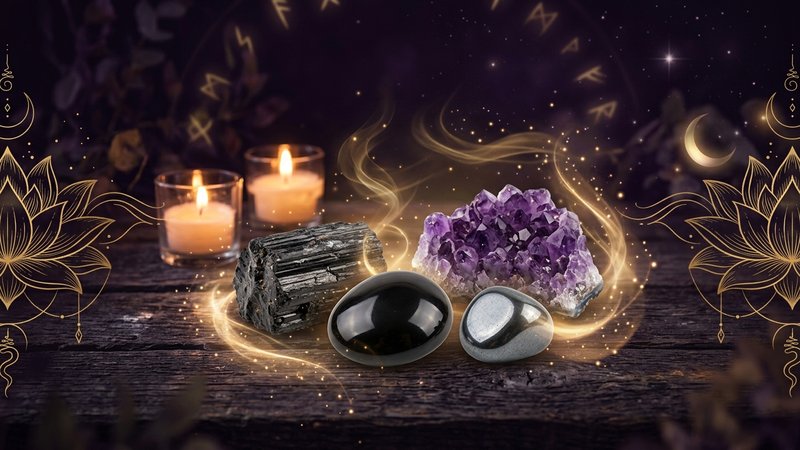
The crystals most widely used for protection in modern practice are black tourmaline, obsidian, smoky quartz, hematite, tiger’s eye, labradorite, amethyst, clear quartz and selenite. Each carries its own traditional association, and each tends to be used in a particular setting: at the entrance to a home, on a desk, in a pocket, or held during meditation.
Protection in this context is a spiritual and symbolic idea rather than a physical one. Crystals do not shield you from harm, illness, accidents or other people’s intentions, and no evidence supports any such effect.
What they do reliably offer is a visible reminder of a boundary you have decided to hold. This guide covers nine stones, where people place them, how to choose, and how to cleanse and recharge them, with the claims kept where they belong.
Why People Use Crystals for Protection
Three quite different motivations sit behind this practice.
As a symbolic anchor. A stone placed by the door or carried in a pocket marks an intention. You notice it, and noticing it prompts you to check your state. This works whatever you believe.
As part of a spiritual tradition. Within crystal practice, certain stones are held to absorb, deflect or ground unwanted influence. That is a belief within a tradition, coherent on its own terms, and not a demonstrated mechanism.
As a transition object. Many people use a pocket stone the way others use a breath count: something to touch when a conversation becomes difficult or a room becomes overwhelming. The stone gives the hand something to do while the mind settles.
One caution before the list. The protection category attracts more fear-based selling than any other part of crystal practice. Anyone telling you that you are under attack, cursed or energetically damaged, and offering stones to fix it, is exploiting anxiety. Responsible practice never works through fear.
What “Protection” Means in Crystal Practice
Within the tradition, protective stones are usually described in one of three ways.
Absorbing. The stone is said to take on unwanted influence, which is why absorbing stones are traditionally cleansed more often than others.
Deflecting. The stone is said to turn influence away rather than take it in. Reflective and dark stones are commonly placed in this category.
Grounding. The stone is said to settle and anchor, on the principle that someone settled is less affected by whatever is around them. This is the category most easily translated into ordinary terms.
What none of this means: protection from illness, accident, crime or another person’s decisions. Treat those as matters for doctors, insurance, sensible precautions and honest conversations.
The honest version is that the practice supports composure. A composed person handles difficult environments better, and that is a real benefit arrived at without any special claim.
Black Tourmaline
Traditional association: grounding and boundaries. The most widely used protective stone in modern practice.
Black tourmaline is typically placed at the entrance of a home, near a desk, or carried as a pocket stone. Practitioners describe it as grounding rather than deflecting, and it is often the stone recommended to someone starting out.
It is commonly paired with hematite for a strongly grounding combination, or with selenite, which many practitioners regard as complementary.
Practical note: raw black tourmaline is brittle and sheds small fragments. A tumbled piece is better for carrying or for anywhere near children and pets.
Obsidian
Traditional association: deflection and honest self-examination.
Obsidian is volcanic glass rather than a crystal in the strict mineralogical sense. It takes a high polish, and its reflective quality is central to how it is used: practitioners speak of it showing you what you would rather not look at.
For that reason, teachers often suggest obsidian is not the first stone to give a beginner. It has a reputation within the tradition for being uncomfortable rather than soothing.
Safety note: obsidian breaks with extremely sharp edges. Keep raw pieces away from children and handle broken pieces carefully.
Amethyst
Traditional association: calm, clarity and protection during reflective practice.
Amethyst is the gentlest stone on this list and the one most often kept in bedrooms and meditation corners. Where the darker stones are associated with boundaries, amethyst is associated with a settled inner state.
It is the usual recommendation for anyone who finds the darker protective stones heavy or unappealing.
Care note: amethyst fades in prolonged sunlight. Charge it in moonlight or in brief early morning sun only.
Clear Quartz
Traditional association: clarity, and amplifying whatever intention it is paired with.
Clear quartz is the general-purpose stone of crystal practice. It is not specifically protective in tradition, but it is used alongside protective stones to reinforce the intention behind them.
Practically, it is durable, widely available, easy to identify and inexpensive. If you want one stone to start with, this is a reasonable choice.
Smoky Quartz
Traditional association: grounding and releasing what feels heavy.
Smoky quartz sits between black tourmaline and clear quartz in character: grounding without being as dense as the darker stones. Practitioners often describe it as the stone for transitions, used when putting down a difficult period rather than defending against an ongoing one.
It is a common choice for a workspace, where something grounding but not visually heavy is wanted.
Tiger’s Eye
Traditional association: courage, steady judgement and grounded confidence.
Tiger’s eye is used where the protection sought is internal rather than environmental: holding your nerve, making a decision under pressure, not being swayed by a forceful person.
It is popular as a bracelet stone for exactly this reason, since the situations it is associated with tend to arise during the working day rather than at home.
Hematite
Traditional association: weight, grounding and returning to the body.
Hematite is noticeably heavy for its size, and practitioners treat that weight as the whole point. It is used when someone feels scattered, over-stimulated or detached from their surroundings.
It pairs conventionally with black tourmaline for grounding work.
Care note: hematite should not be soaked in water, as it can rust and lose its surface. Cleanse it with smoke, sound or dry methods.
Labradorite
Traditional association: boundaries around the self, particularly for those who absorb others’ moods.
Labradorite shows a distinctive flash of colour when it catches the light, and the tradition makes something of that: a stone that reveals itself only at certain angles, associated with keeping your own state your own.
It is the stone commonly suggested for people in caring, teaching, healing or client-facing work, where absorbing other people’s states is an occupational pattern.
Selenite
Traditional association: clearing and lightness, and cleansing other stones.
Selenite occupies a dual role. It is used as a protective and clearing stone in its own right, often placed in a main room or by a bedside, and it is also the most common tool for cleansing other crystals.
Important care note: selenite is a soft mineral, around 2 on the Mohs scale, and it is water-soluble. Never wash it, never leave it in a damp bathroom, and handle it gently, as it scratches and flakes easily.
Protection Crystal Reference Table
| Crystal | Traditional Association | Common Use | Suggested Placement |
|---|---|---|---|
| Black tourmaline | Grounding, boundaries | General protection, daily carry | Entrance, desk, pocket |
| Obsidian | Deflection, self-examination | Reflective practice, transitions | Meditation space, not the bedroom |
| Amethyst | Calm, clarity | Rest, meditation, gentle protection | Bedroom, meditation corner |
| Clear quartz | Clarity, amplification | Paired with other stones | Anywhere, main living space |
| Smoky quartz | Grounding, release | Putting down a difficult period | Workspace, study |
| Tiger’s eye | Courage, steady judgement | Decisions, difficult conversations | Worn as a bracelet, pocket |
| Hematite | Weight, grounding | Feeling scattered or over-stimulated | Pocket, desk, hand during practice |
| Labradorite | Personal boundaries | Client-facing and caring work | Worn, or kept in a work bag |
| Selenite | Clearing, lightness | Clearing spaces and other stones | Main room, bedside, dry places only |
How to Choose a Crystal
Two questions narrow it quickly.
What is the situation? Feeling scattered points to hematite or smoky quartz. Absorbing other people’s moods points to labradorite. Wanting a general daily stone points to black tourmaline. Wanting calm rather than boundary points to amethyst.
Which stone do you actually respond to? If buying in person, handle several and notice which you keep returning to. Weight, texture and colour matter more than a recommended list.
Practical buying checks:
- ask whether a stone is natural, dyed or reconstituted, and expect a straight answer
- dyed howlite is regularly sold as turquoise, and dyed quartz stands in for several stones
- perfectly uniform colour across a cheap set usually indicates dye
- buy two or three stones you will use rather than a large set you will store
Price is not a measure of spiritual value. A small tumbled stone carried daily does more in practice than an expensive cluster on a shelf.
Crystals for the Home
Common placements and the reasoning behind them:
- Entrance: black tourmaline or hematite, marking the boundary between outside and inside
- Main living room: clear quartz or selenite, associated with clarity and openness
- Bedroom: amethyst, for rest. Many practitioners avoid darker stones here.
- Meditation corner: whichever stone you use in practice, kept in one place
- Study: smoky quartz or clear quartz
A reasonable starting point is two stones rather than nine: one at the entrance and one where you spend most of your time.
Crystals for Work
The workplace is where most people actually want composure, and small stones work better than display pieces.
- Desk: black tourmaline or smoky quartz, discreet enough not to invite comment
- Pocket: hematite or tiger’s eye, for touching during difficult moments
- Bag: labradorite, particularly for client-facing roles
- Worn: a bracelet, which is the most practical option since it is always with you
Set yourself one rule: when you notice the stone, take one slow breath and drop your shoulders. That single habit produces more benefit than any belief about the mineral.
Crystals in Meditation
Crystals are optional in meditation. Where used, keep it simple.
A ten-minute practice: hold one stone in the palm, breathe slowly for two minutes with attention on its weight and temperature, name the quality you are practising, then sit quietly for the remainder.
Working with one stone for several weeks teaches more than rotating through a collection. The familiarity is part of what makes the object useful.
Some practitioners place a stone at a corresponding chakra while lying down. If that interests you, the colour correspondences are set out in our guide to clearing and balancing the energy centres.
Crystal Bracelets
A bracelet is the most practical format for protection work, because a stone you are wearing gets noticed and a stone in a drawer does not.
What to check:
- Bead size: 8mm suits most adults, 6mm for slimmer wrists
- Cord: double-strung elastic lasts considerably longer
- Honesty: ask which beads are natural, dyed or reconstituted
- Comfort: a heavy or scratchy bracelet will not be worn
Single-stone bracelets in black tourmaline, tiger’s eye or hematite are the usual protective choices. Many people stack one alongside a seven-stone chakra bracelet, pairing a specific intention with the full sequence. Our wider crystal collection includes both.
Remove bracelets before bathing, swimming and heavy physical work, and store them flat rather than hanging.
Cleansing and Recharging
Absorbing stones are traditionally cleansed more often than others, so protective stones tend to need the most regular attention. Monthly is a reasonable rhythm, plus after any difficult period.
Safe methods:
- smoke from incense, sage or camphor
- sound from a bell or singing bowl
- resting smaller stones on a larger piece of selenite or clear quartz overnight
- dry salt placed nearby, not in direct contact
- earth contact for a few hours
Water cautions that matter: never soak selenite, which dissolves. Avoid water for hematite, which rusts, and for porous stones including turquoise, howlite and lapis lazuli. Avoid water entirely for elastic-strung bracelets, since it degrades the cord.
For recharging, moonlight is the traditional method, and brief early morning sun works for durable stones. Amethyst, rose quartz, citrine and fluorite fade in prolonged sunlight, so keep sun exposure short. The step-by-step version is in our full moon charging ritual, and the bracelet-specific method is covered in our guide to caring for crystal bracelets.
Energy Shielding vs Crystal Symbolism
Worth separating these clearly, because they are often sold together.
Crystal symbolism is an object carrying an intention. Its function is to remind you.
Energy shielding is a practice, usually involving visualization and breath before entering a demanding environment, alongside the far more important practical side: what you agree to, who you spend draining hours with, how much conflict you absorb before bed.
A stone in your pocket does nothing about a colleague who consistently drains you. That is a boundary conversation, not a crystal problem. The stone can remind you to have it, which is a genuine contribution and a modest one.
Our full guide to protecting your energy in daily life covers both the symbolic and the practical sides.
Frequently Asked Questions
What are the best crystals for protection?
The most widely used are black tourmaline, obsidian, smoky quartz, hematite, tiger’s eye, labradorite, amethyst, clear quartz and selenite. Black tourmaline is the usual starting point for general daily use. These are traditional associations within crystal practice rather than demonstrated effects.
Which crystal is best for protection at home?
Black tourmaline or hematite near the entrance is the most common choice, marking the boundary between outside and inside. Selenite or clear quartz suits a main living room, and amethyst is the usual bedroom stone. Two well-placed stones work better than a large collection spread thinly.
Do protection crystals actually work?
Not in any physical sense. Crystals do not shield you from harm, illness, accidents or other people’s intentions, and no evidence supports such claims. What they offer is a visible reminder of an intention you have set, which supports composure. That is a real benefit within an honest description.
How do I cleanse protection crystals?
Use smoke, sound, dry salt placed nearby, earth contact, or rest smaller stones on selenite overnight. Avoid water for selenite, which dissolves, for hematite, which rusts, for porous stones such as turquoise and howlite, and for elastic-strung bracelets. Monthly is a reasonable rhythm for protective stones.
Can I wear protection crystals every day?
Yes, and daily wear is the most practical format, since a worn stone is noticed and a stored one is not. Black tourmaline, tiger’s eye and hematite are common choices for bracelets. Remove them before bathing, swimming and heavy physical work, and store bracelets flat to preserve the elastic.
Which crystals should I not keep in the bedroom?
Practitioners commonly avoid obsidian in bedrooms, since it is traditionally associated with confronting rather than settling. Some also find the heavier grounding stones unrestful at night. Amethyst is the usual bedroom recommendation. This is convention within the tradition rather than a rule, so follow what you find restful.
What does protection mean in crystal practice?
Within the tradition, protective stones are described as absorbing unwanted influence, deflecting it, or grounding the person carrying them. None of this means protection from illness, accident or crime. The honest interpretation is that the practice supports composure, and a composed person handles difficult environments better.
Bringing It Together
Protection crystals earn their place as reminders rather than as shields. Choose two or three that suit your actual situation, place them where they will be seen, cleanse them when the ritual feels due, and let noticing them prompt a breath and a check on your state.
Be particularly wary of anyone selling these stones through fear. The practice is at its best when it is quiet, ordinary and honest about what it does.
At The Golden Lotus, our stones are prepared and energized as companions to intention and awareness, never as guarantees. If you would like to begin, our consecrated crystal collection is a considered place to start, and we are happy to suggest which stone suits your situation before you buy anything.

Have Questions About This Practice?
Whether you want to learn Reiki, explore Mesmerism, or book a 1-on-1 private energy alignment session, we welcome your questions.