
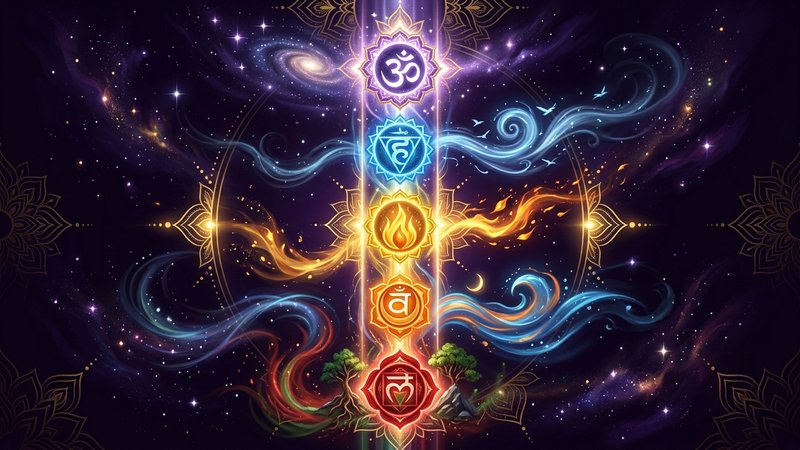
In the most widely taught version of the chakra system, the lower five centres are associated with the five great elements of Indian philosophy: earth at the root, water at the sacral, fire at the solar plexus, air at the heart and space or ether at the throat. The third eye and crown sit above the elemental range, associated instead with mind, light and consciousness.
The pairing is not decorative. It gives each centre a quality you can actually work with, because everyone already knows what solid ground feels like compared with flowing water, or warmth compared with open space.
This guide sets out each chakra and its element, what the pairing traditionally means, and how elements are used in meditation, visualization and grounding practice.
The Relationship Between Chakras and Elements
The elements in question are the pancha mahabhuta, the five great elements of Indian philosophy: prithvi, apas, agni, vayu and akasha. They are not the chemical elements, and they are not a description of matter in the modern sense.
They are better understood as qualities of experience. Earth is what is solid, stable and slow to change. Water is what flows and takes the shape of its container. Fire transforms. Air moves and connects. Space is what allows everything else to exist within it.
Mapping these onto the chakras gives the system its progression. The base of the sequence is dense and stable, and each step upward becomes subtler, until the elements themselves are left behind at the third eye and crown.
That movement from gross to subtle is the real teaching here. The individual correspondences matter less than the direction of travel.
An Important Note: Associations Vary by Tradition
Before the chart, a caveat that most articles omit.
The chakra system is not one system. It developed across many centuries and many tantric and yogic lineages, and those lineages differ on the number of centres, their attributes, their colours and their correspondences. Some texts describe five centres, some six, some more. Attributes assigned to a given chakra in one text may differ in another.
The element correspondences given below are the most widely taught version, and they are well grounded in traditional sources. They are not the only version, and they should not be presented as a single scientifically correct chart. There is no such thing.
Nor are the elements physical claims. Saying the root chakra relates to earth is not a statement about geology or about the body’s mineral content. It is a description of a quality.
Where sources disagree, they are usually drawing on different traditions rather than one of them being wrong. Hold the chart firmly enough to practise with and loosely enough to learn from.
Chakra and Element Overview Chart
| Chakra | Sanskrit Name | Element | Sanskrit Element | Quality It Points To |
|---|---|---|---|---|
| Root | Muladhara | Earth | Prithvi | Solidity, stability, support |
| Sacral | Svadhisthana | Water | Apas | Flow, feeling, adaptability |
| Solar Plexus | Manipura | Fire | Agni | Transformation, will, heat |
| Heart | Anahata | Air | Vayu | Movement, connection, spaciousness |
| Throat | Vishuddha | Space or Ether | Akasha | Openness, resonance, expression |
| Third Eye | Ajna | Mind or light | Manas, in some sources | Perception, insight, clarity |
| Crown | Sahasrara | Beyond the elements | None | Consciousness, stillness, transcendence |
Root Chakra and Earth
Element: earth, prithvi. Quality: solidity.
Earth is what holds weight without moving. It is slow, dense and reliable, and those qualities describe exactly what the root chakra is traditionally concerned with: safety, shelter, belonging, and the sense of having something underneath you.
The practical translation is straightforward. When the root is unsettled, people describe feeling unable to land. Nothing feels solid, plans feel provisional, and rest does not restore.
Earth practices are therefore physical rather than contemplative: walking, standing barefoot on the ground, handling soil, cooking, and any routine that repeats reliably. The traditional instruction to begin chakra practice at the base makes sense in these terms. You cannot build on what has not settled.
Sacral Chakra and Water
Element: water, apas. Quality: flow.
Water takes the shape of whatever holds it, moves without resistance, and cannot be gripped. The sacral chakra’s themes follow directly: emotion, creativity, pleasure and adaptability.
The element gives you a useful diagnostic vocabulary. In traditional terms, difficulty here appears as water either frozen, where emotion has become numb and creativity has stalled, or flooding, where feeling overwhelms everything else. Neither is failure. Both describe a quality that has lost its movement.
Water practices tend towards ease: bathing, swimming, fluid movement, creative work with no fixed outcome, and anything done for enjoyment rather than achievement.
Solar Plexus and Fire
Element: fire, agni. Quality: transformation.
Agni is one of the oldest and most important concepts in Indian thought, associated with digestion, transformation and the capacity to convert one thing into another.
At the solar plexus, that becomes will: the capacity to turn intention into action, to decide, to assert, to follow through. Fire is also the element that most obviously needs regulation. Too little and nothing moves. Too much and it consumes what it was meant to serve.
Traditional practice here aims at steady warmth. Fire practices include sunlight on the skin, sitting with a lamp or flame, breath practices that generate warmth, and physical effort that builds heat gradually rather than in bursts.
Heart Chakra and Air
Element: air, vayu. Quality: movement and connection.
Air moves freely, occupies space without weight, and passes between things. At the heart it becomes connection: love, compassion, and the capacity to be affected by another person.
The heart sits at the middle of the sequence, and the element choice reflects that. Below it, the elements are dense. Above it, they are subtle. Air is the turning point, still tangible but barely so.
Breath is the obvious practice, since it is air made deliberate. Expanding the breath laterally across the chest, rather than only up and down, is a common heart practice. So is anything that involves genuine contact with another person.
Throat Chakra and Space
Element: space or ether, akasha. Quality: openness and resonance.
Akasha is the subtlest of the five, usually rendered as space or ether. It is not emptiness in a negative sense. It is the openness that allows anything else to exist, and the medium in which sound travels.
That connection to sound is why akasha belongs to the throat. Expression requires space in two senses: physical space for sound to move through, and the space a person is given, or takes, to speak.
Traditional practices are vocal: chanting, mantra, recitation, singing. Silence is equally a throat practice, since knowing when not to speak belongs to the same capacity.
Third Eye and the Subtle Mind
Element: beyond the five, associated with mind or light.
At Ajna, the elemental scheme is generally left behind. Sources differ on what takes its place. Some associate the third eye with manas, the mind, others with mahat or with light itself, and some decline to assign anything at all.
The reasoning within the tradition is that Ajna is where the elements are said to dissolve back into their source. The centre is associated with perception rather than with substance.
This is also where traditions diverge most, so anyone presenting a definitive third eye element is overstating a contested point. Practices here are quiet and inward: stillness, observation of thought, and restraint. Teachers commonly warn against intensive third eye focus without a settled root practice underneath it.
Crown Chakra and Consciousness
Element: none.
Sahasrara is consistently described as beyond elemental classification. Where the lower centres are associated with qualities of manifestation, the crown is associated with what is prior to it: pure awareness, or consciousness without object.
In classical description the crown is less a centre to be worked on than a state arrived at. This differs sharply from modern chakra practice, which tends to treat all seven as equivalent stations in a sequence to be balanced.
Practices, to the extent the word applies, are the quietest: silent sitting, surrender, letting attention rest without direction.
How Elements Are Used in Chakra Meditation
The element gives your attention something concrete to hold, which is why element-based meditation often suits people who struggle with colour visualization.
A complete practice, about twelve minutes:
- Settle for two minutes, breathing naturally.
- Root, five breaths. Feel weight and contact with the ground. Quality: solid.
- Sacral, five breaths. Let the breath and body feel soft and fluid. Quality: flowing.
- Solar plexus, five breaths. Notice warmth in the abdomen. Quality: warm, not hot.
- Heart, five breaths. Let the breath widen across the chest. Quality: spacious.
- Throat, five breaths. Notice the passage of air through the throat. Quality: open.
- Third eye, five breaths. Hold attention lightly between the brows. Quality: clear.
- Crown, five breaths. Nothing to do. Quality: still.
- Return attention to the root and ground for a minute before opening your eyes.
Always close at the root. Ending at the crown leaves many people scattered rather than settled.
Element-Based Visualization
Where colour visualization feels arbitrary, elemental imagery often lands more naturally because it draws on sensations you already know.
- Earth: the weight of a stone in the hand, or the density of packed ground beneath you
- Water: a slow current, or the way water finds its own level
- Fire: the steady warmth of a lamp flame rather than a blaze
- Air: a breeze moving through an open room
- Space: the openness of a large hall, or the pause between two sounds
Use sensation rather than picture if you do not visualise easily. Feeling weight at the base of the spine is the same practice as imagining earth there.
Some practitioners also work with a colour-matched object or a seven-stone bracelet as a tactile guide through the sequence, one bead per centre. It is optional, and the practice works without it.
Grounding Exercises
Earth practices deserve separate treatment, because grounding is what makes everything else workable.
- stand barefoot on grass or earth for three to five minutes
- sit with both feet flat on the floor and give one full minute to the sensation of contact
- walk slowly, attending to each footfall, for five minutes
- hold something heavy, a stone or a full vessel, and notice the weight
- eat something warm and cooked, slowly and without a screen
- work with your hands: cooking, gardening, cleaning, repair
Use one of these after any chakra practice, after intensive breathwork, and whenever you feel scattered. It takes a minute and changes the outcome of the whole session.
Chakra Balancing Practices Using the Elements
Rather than working through all seven, the elemental framing lets you address whatever is actually asking for attention.
- Feeling unsettled and unable to land: earth. Walk, stand on the ground, establish a routine, sit with weight.
- Feeling numb, stuck or creatively blocked: water. Bathe, move fluidly, make something with no purpose.
- Unable to decide or act: fire. Sunlight, warmth, one small completed action today.
- Closed off or holding resentment: air. Widen the breath, spend real time with someone, get outside.
- Unable to say what you mean: space. Chant, hum, write it out first, and give yourself room to speak.
This is chakra work as self-observation rather than as ritual, and it tends to be more useful than mechanically running the sequence.
Those wanting to go further usually combine elemental awareness with energy practice. Chakra work features throughout Reiki training, and our advanced Reiki study covers symbol and crystal work alongside deeper personal practice. The broader relationship between body, attention and inner state is explored in our writing on integrated mind and body practice, and practical routines for each centre are set out in our guide to clearing and balancing the energy centres.
Frequently Asked Questions
What are the elements of the 7 chakras?
In the most widely taught version, earth belongs to the root, water to the sacral, fire to the solar plexus, air to the heart and space or ether to the throat. The third eye is associated with mind or light rather than a material element, and the crown is described as beyond elemental classification entirely.
What is the root chakra element?
Earth, prithvi in Sanskrit. It points to solidity, stability and support, which matches the root chakra’s traditional concerns with safety, shelter and belonging. Earth practices are physical rather than contemplative: walking, standing barefoot on the ground, reliable routine and any work done with the hands.
What is the sacral chakra element?
Water, apas in Sanskrit. Water takes the shape of what holds it and moves without resistance, which mirrors the sacral chakra’s themes of emotion, creativity and adaptability. Traditional practice here favours ease over effort, including bathing, fluid movement and creative work with no fixed outcome.
Do all traditions agree on the chakra elements?
No. The chakra system developed across many tantric and yogic lineages over centuries, and they differ on the number of centres and their attributes. The five-element mapping of the lower chakras is well grounded and widely taught, but it is one version rather than a single correct chart, particularly at the third eye.
Why do the third eye and crown have no element?
Within the tradition, the elements describe qualities of manifestation, and the upper two centres are understood to lie beyond that range. Ajna is where the elements are said to dissolve back towards their source, and Sahasrara is associated with consciousness itself rather than with any quality of substance.
How do you use the elements in chakra meditation?
Move attention through the centres and hold the quality of each element rather than a colour: weight at the root, flow at the sacral, warmth at the solar plexus, spaciousness at the heart, openness at the throat, clarity at the third eye, stillness at the crown. Finish by grounding at the root.
Are the chakra elements the same as chemical elements?
No. They are the pancha mahabhuta of Indian philosophy, understood as qualities of experience rather than as physical substances. Earth means solidity, water means flow, fire means transformation. None of this makes a claim about chemistry or about the body’s physical composition.
Bringing It Together
The elements give the chakra system something the colour scheme cannot: a set of qualities you already understand from experience. You know what solid feels like, and what flowing, warm, spacious and open feel like. That makes the practice immediate rather than abstract.
Learn the correspondences, use them, and hold them loosely enough to notice when a source disagrees. The traditions are genuinely plural, and that is a feature of a living system rather than a flaw in it.
At The Golden Lotus, elemental and chakra awareness runs through the energy work we teach, from foundational practice upwards. If you would like guided support rather than working alone, our chakra balancing consultation is a considered place to start.
Have Questions About This Practice?
Whether you want to learn Reiki, explore Mesmerism, or book a 1-on-1 private energy alignment session, we welcome your questions.