
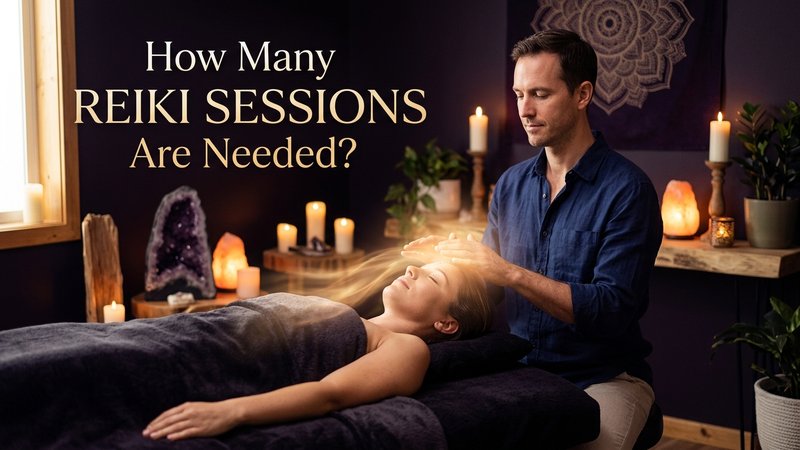
There is no universal number. Anyone who tells you that Reiki requires a fixed course of four, six or twelve sessions is describing their own package rather than a tradition.
What is true in practice: many people try one session out of curiosity and stop there. Others return occasionally, when life gets heavy. A smaller number build Reiki into a regular rhythm the way they might with yoga or meditation. All three are legitimate.
This guide explains what actually happens in a session, why people choose one versus several, what influences frequency, and the questions worth asking a practitioner before you book anything.
One boundary throughout. Reiki is a relaxation and spiritual practice, not a medical treatment. It does not cure or manage illness, no session schedule should be presented as a treatment plan, and Reiki should never delay or replace care from a qualified doctor.
What Happens During a Reiki Session?
Knowing the shape of a session makes the frequency question much easier to think about.
A typical session:
- Conversation first. The practitioner asks what brings you, what you would like from the session, and whether anything should be avoided. This is also when you should ask your own questions.
- You lie down, fully clothed, usually on a treatment table, sometimes seated if lying down is uncomfortable.
- The practitioner works through hand positions, either resting hands lightly on the body or holding them just above it. Light touch or no touch is your choice and should be agreed beforehand.
- You rest. Most people simply lie still. Some fall asleep, which is fine.
- A short close. A few minutes to sit up slowly, a glass of water, and a brief conversation about how it went.
What people commonly report: warmth, heaviness, deep relaxation, occasional emotional release, sometimes nothing much at all. Feeling nothing is common and does not mean the session failed.
If the practice itself is unfamiliar, our beginner’s guide to Usui Reiki covers the background this article assumes.
One Session vs Multiple Sessions
A single session suits curiosity, a stressful week, a specific moment such as before travel or after a difficult event, or simply wanting to know what it is like before deciding anything. Many people never go beyond one, and that is a complete and reasonable experience.
Multiple sessions suit people who found the first restful and want to build on it, those going through a sustained difficult period, and anyone using Reiki as part of an ongoing personal or spiritual practice.
The honest framing: multiple sessions are a choice about how you want to spend your time and money, not a requirement created by the practice. If a practitioner tells you a single session cannot work or that you must complete a course, that is a sales structure rather than a tradition.
Why People Choose Recurring Sessions
Three reasons come up most often, and they are quite different from each other.
Relaxation and General Wellbeing
The most common reason. An hour of lying still with no phone, no demands and someone paying quiet attention is restorative on its own terms. People who book monthly often describe it much as they would a regular massage or a long walk: a protected hour that helps them reset.
This requires no particular belief and no claims beyond rest.
Spiritual Practice and Self-Awareness
For others, Reiki forms part of a wider reflective practice alongside meditation, prayer or journalling. Regular sessions mark a rhythm, and the quiet often brings things to the surface that a busy week keeps down.
Here the frequency tends to follow the practice rather than any recommendation. People with an established meditative rhythm usually settle into one naturally.
Energy-Balancing Goals
Some people come with a specific intention: feeling ungrounded, going through a transition, or wanting to work with a particular area of life. Within spiritual traditions this is described as energy balancing, and a short series of sessions is a common way to give that intention sustained attention.
Be clear about what kind of claim that is. Energy balancing is a traditional spiritual framing, not a measurable outcome. Nobody can assess your energy in a way that could be verified, and any practitioner who diagnoses blockages and prescribes a course of sessions to clear them has moved outside responsible practice.
Factors That Influence Session Frequency
Practically, these are what determine how often people come:
- What you want from it. Rest, reflection, or a specific intention.
- Cost and time. A significant and entirely legitimate factor. Sessions should fit your life, not strain it.
- How you responded to the first one. Some people feel a clear difference, others do not.
- Whether you have your own practice. People who practise Reiki or meditate themselves usually need fewer sessions.
- What is happening in your life. Grief, transitions and sustained stress lead people to come more often.
- Distance and access. Whether you can reach a practitioner easily, or work at distance.
A pattern many practitioners observe: people come more frequently at first, then settle into something occasional once the initial interest has been satisfied.
What Beginners Can Expect
Honest expectations make the first session better.
- You may feel a great deal, a little, or nothing. All are normal.
- The most common report is simply deep relaxation.
- Some people feel tired afterwards, others alert. Drink water and do not plan anything demanding immediately after.
- Occasional emotional response during a session is normal and not a cause for alarm.
- It will not resolve a long-standing difficulty in an hour, and any practitioner suggesting otherwise should be treated with caution.
- You are in control. You can ask to stop, change position, or have hands kept off the body at any point.
How Long Do Reiki Sessions Usually Last?
Most sessions run between forty-five and ninety minutes, with sixty minutes being the common standard.
Roughly:
- Twenty to thirty minutes: short sessions, often for children, elderly clients or a first taster
- Sixty minutes: the usual full session, including conversation at both ends
- Ninety minutes: longer sessions, sometimes combining Reiki with extended discussion
The hands-on portion is typically shorter than the booked time, since conversation before and after is part of the appointment. Ask what a given session includes when you book, as structures differ between practitioners. Our full range of personal sessions sets out what each involves.
Can You Receive Reiki Too Often?
There is no traditional concept of overdose, and Reiki is not understood to accumulate in a way that could become excessive.
That said, two practical cautions are worth stating.
Financially. Frequent sessions add up. If a schedule is straining your budget, that is a reason to reduce it, and a good practitioner will say so themselves.
In terms of dependence. If sessions are becoming the only thing that helps, or if you feel you cannot cope without booking another, that is worth examining honestly. Reiki is meant to support your own steadiness, not to become the sole source of it. In that situation, learning to practise yourself often serves better than booking more appointments.
For most people, weekly at the most intensive, moving to monthly or occasional, is a sensible upper end.
Reiki Sessions vs Learning Reiki Yourself
This is the decision many regular clients eventually face, and it is worth putting plainly.
Receiving sessions means no training commitment, the benefit of someone else’s experience, a protected hour where you do nothing, and an ongoing cost per session.
Learning Reiki means an upfront course cost, a daily practice commitment, the ability to practise on yourself whenever you want, and no per-session expense afterwards.
The arithmetic is straightforward for anyone booking regularly. If you are having monthly sessions and expect to continue, a foundational course generally costs less within the first year and gives you something you keep. Our Level 1 and 2 training begins with exactly this self-practice.
They are not mutually exclusive. Many practitioners receive sessions from others, because being treated is a different experience from treating yourself.
Questions to Ask Your Practitioner
Before booking, ask:
- What is your training and lineage? They should be able to name their teacher and level.
- What does a session involve, and how long is it? Including how much is hands-on.
- Do you use touch, or hands off the body? Your preference should be respected.
- What do you say Reiki can and cannot do? Any claim to cure or treat illness should end the conversation.
- Do you require a package? Being pressured into a fixed course is a warning sign.
- What happens if I feel emotional during a session? A good practitioner has a considered answer.
- What is your cancellation and refund policy?
Two further signals. A practitioner who asks about your medical care and encourages you to continue it is practising responsibly. One who suggests reducing medication, or who frames a diagnosed condition as an energy blockage, is not, and you should leave.
If you would like to begin with a single session and decide afterwards, our one-to-one energy healing session is offered individually rather than as a package, and a chakra balancing consultation is available for those who want a more structured focus.
Frequently Asked Questions
How many Reiki sessions are needed?
There is no fixed number. Many people have one session out of curiosity, others return occasionally during difficult periods, and some build Reiki into a regular monthly rhythm. Any practitioner presenting a required course of a set number of sessions is describing a sales package rather than a tradition.
How often should you have Reiki?
Entirely a matter of preference and circumstance. Weekly is the most intensive pattern people typically choose, usually for a short period, with monthly or occasional being far more common over the long term. What you want from it, along with cost and time, should determine the rhythm.
How long does a Reiki session last?
Most sessions run between forty-five and ninety minutes, with sixty minutes the common standard. The hands-on portion is usually shorter, since conversation before and after forms part of the appointment. Shorter sessions of twenty to thirty minutes are often used for children, elderly clients or a first taster.
Can you have too much Reiki?
There is no traditional concept of receiving too much, and Reiki is not understood to accumulate harmfully. The practical limits are financial and psychological. If sessions strain your budget, or if you feel unable to cope without booking another, reduce the frequency. Learning to practise yourself is often the better route.
Will one Reiki session be enough?
For many people, yes. A single session is a complete experience, particularly if you are curious or want rest after a difficult period. Whether to return is a choice about how you want to spend your time, not a requirement created by the practice.
Is it better to have Reiki sessions or learn Reiki myself?
Both have their place. Sessions require no training commitment and give you a protected hour of someone else’s attention. Learning gives you daily self-practice and no per-session cost. For anyone booking regularly, a foundational course usually works out less expensive within the first year.
Can Reiki replace medical treatment?
No. Reiki is a relaxation and spiritual practice, not a medical treatment, and it does not cure or manage any condition. It should never delay or replace care from a qualified doctor. Any practitioner who suggests otherwise, or who advises reducing medication, is acting irresponsibly.
Bringing It Together
How many Reiki sessions you need is really a question about what you want from them. One, if you are curious. A few, if you are going through something. A regular rhythm, if it has become part of how you look after yourself.
What should never decide it is pressure. A good practitioner will tell you honestly that one session is fine, will not sell you a package you did not ask about, and will actively encourage you to continue with any medical care you are receiving.
At The Golden Lotus, sessions are offered individually so you can decide afterwards rather than before. If you are unsure which would suit you, ask us, and we will tell you plainly, including when the answer is that a single session is all you need.
Have Questions About This Practice?
Whether you want to learn Reiki, explore Mesmerism, or book a 1-on-1 private energy alignment session, we welcome your questions.