
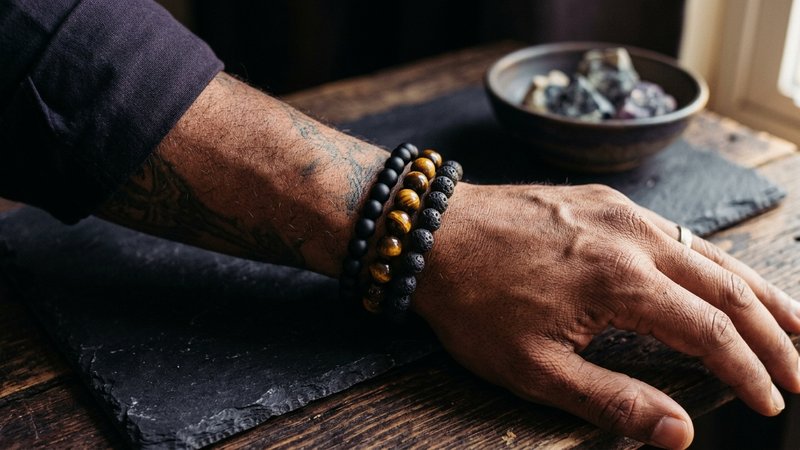
Healing bracelets for men are beaded gemstone bracelets worn as a daily reminder of an intention, most commonly made from black tourmaline, tiger’s eye, hematite, amethyst, clear quartz or a seven-stone chakra set.
The stones most men gravitate towards are the darker, heavier ones, partly for how they look and partly because their traditional associations, grounding, steadiness and courage, match what people tend to want from something worn to work.
This guide covers the popular stones and what each traditionally represents, how to choose a size that lasts, the left wrist versus right wrist question, and how to care for a bracelet properly.
The honest framing first: these are symbolic pieces. The meanings attached to the stones belong to spiritual tradition, not to science, and no bracelet protects anyone from harm, illness or misfortune.
What Is a Healing Bracelet?
A healing bracelet is a beaded bracelet made from gemstones, worn for the meaning attached to the stones rather than only as jewellery.
Construction is usually simple: round polished beads, most commonly 8mm, strung on elastic cord. Better pieces are double-strung, since elastic is the usual point of failure. Some designs add a lava bead for essential oil, or a charm such as an Om symbol or a rudraksha bead.
Within crystal traditions, each stone carries associations built up over long use. Black tourmaline is linked to grounding, tiger’s eye to courage, amethyst to calm. These are traditional meanings rather than demonstrated properties, and a good seller will describe them that way.
The practical function is straightforward and requires no belief at all. A bracelet sits in your line of sight dozens of times a day, and each glance is a small prompt to check your state.
Why Men Wear Crystal Bracelets
Four reasons come up most often.
As a reminder. A specific intention attached to a specific object: hold your nerve in the meeting, do not send the email angry, slow down.
As a discreet practice. For men whose spiritual practice is private, a bracelet is one of the few ways to carry something outward without announcing it.
As a tactile anchor. Something to touch when a conversation gets difficult. This is genuinely useful and entirely unmysterious.
As jewellery with meaning. Many men wear little jewellery, and a stone bracelet is understated enough for most workplaces while still meaning something.
There is no separate men’s crystal tradition. The stones and their meanings are the same regardless of who wears them. What differs is usually bead size, colour preference and how the piece is styled.
Popular Stones for Men’s Bracelets
Black tourmaline. The most common choice. Traditionally associated with grounding and boundaries, and often worn during demanding periods at work. Matte black, which suits most wardrobes.
Tiger’s eye. Golden brown with a distinctive banded shimmer. Traditionally associated with courage, steady judgement and holding your nerve under pressure. The most popular stone for men after black tourmaline.
Hematite. Metallic grey, noticeably heavy for its size. Traditionally associated with grounding and returning to the body, and often chosen by people who feel scattered or over-stimulated. Do not soak it, as it rusts.
Amethyst. Purple, traditionally associated with calm and reflection. The usual choice for anyone wanting something settling rather than bracing. Fades in prolonged sunlight.
Clear quartz. The general-purpose stone, associated with clarity and often worn alongside another stone to reinforce its intention. Durable and inexpensive.
Chakra stone sets. Seven colour-matched stones covering the traditional energy centres. More colourful than the single-stone options, which some men like and others do not.
Other stones worth knowing: lava stone, which is porous and often paired with essential oil; rudraksha beads, which carry devotional significance in Indian tradition rather than crystal associations; and sandalwood, traditional and light to wear.
Chakra Bracelet for Men
A chakra bracelet strings seven stones in the traditional colour order, from red at the root to violet or white at the crown, usually with neutral beads filling out the band.
For a more understated look, many men choose a design where the seven colours sit against black lava, matte onyx or grey hematite rather than running the full band. The colours are present without the piece reading as bright.
Worn deliberately, the seven-stone sequence functions as a compact reminder of a balanced life: stability, creativity, confidence, warmth, honesty, clarity and stillness. Our Seven Chakra Bracelet uses 8mm stones in the traditional order and is prepared and energized before dispatch.
Meaning of the Seven Chakra Colours
| Colour | Chakra | Traditional Theme |
|---|---|---|
| Red | Root | Stability, safety, grounding |
| Orange | Sacral | Creativity, emotion, enjoyment |
| Yellow | Solar plexus | Confidence, willpower, decisions |
| Green | Heart | Compassion, connection, warmth |
| Blue | Throat | Honesty, expression, clear speech |
| Indigo | Third eye | Clarity, insight, perception |
| Violet or white | Crown | Awareness, stillness, perspective |
Read the sequence as a map of a whole person: the practical foundation at one end, reflective awareness at the other.
Left Wrist vs Right Wrist
The common convention holds that the left side receives and the right side gives.
By that logic, wear a bracelet on the left when you want to draw a quality inward, such as calm or grounding, and on the right when you want to express one outward, such as confidence or clear communication.
Most people wear these bracelets on the left, since the usual intention is to settle rather than project.
Practically, the non-dominant wrist takes less wear, which for most men means the left. If you wear a watch, the other wrist is the obvious answer.
Honestly, there is no verifiable difference between the two, and traditions themselves disagree. We have covered the full argument and where the convention comes from in our article on which wrist to wear a bracelet on.
How to Choose the Right Size
This is the practical detail most people get wrong, and it determines whether the bracelet survives the year.
Measuring: wrap a strip of paper or a tape measure snugly around your wrist and note the measurement. Add roughly 1.5 to 2 cm for an 8mm bead bracelet. Men’s wrists commonly measure between 17 and 20 cm, so most men need a bracelet in the 18.5 to 22 cm range.
Bead size:
- 8mm: the standard, suits most adult men
- 10mm: heavier and more substantial, popular with larger wrists
- 6mm: slimmer, better for stacking than wearing alone
Fit: it should move a little on the wrist but not slide over the hand. Too tight is the main cause of breakage, because the elastic is under constant tension.
If between sizes, go slightly larger. A loose bracelet is comfortable. A tight one snaps.
How to Wear a Crystal Bracelet
- Put it on deliberately in the morning rather than absently. Thirty seconds of attention is the difference between jewellery and practice.
- Remove it before bathing, swimming, the gym, heavy lifting and applying lotion or cologne.
- Keep it off metal watch edges, which chip beads over time.
- Store it flat in a pouch rather than hanging, which stretches the cord.
- Set one rule: when you notice it, take one slow breath and drop your shoulders. That single habit produces more benefit than any belief about the stones.
How to Cleanse It
Cleansing is the traditional practice of clearing a piece before resetting an intention. Elastic-strung bracelets need gentler handling than loose stones.
Safe methods:
- pass it briefly through incense, dhoop or camphor smoke
- ring a bell or singing bowl near it
- rest it on a piece of selenite or clear quartz overnight
- place it beside, not in, a small bowl of dry salt
- hold it, breathe slowly, and mentally clear it
Avoid soaking in water or salt water. Water degrades elastic, damages metal charms, and harms porous or metallic stones including hematite, turquoise, howlite and lapis lazuli. Our full method is in the guide to caring for crystal bracelets.
Once a month is a sensible rhythm, plus after an unusually heavy stretch.
How to Recharge It
Recharging restates the purpose after clearing.
- Moonlight overnight on a windowsill, traditionally on the full moon. The step-by-step version is in our full moon charging ritual.
- Brief morning sunlight, an hour at most, and not for amethyst or citrine, which fade.
- Earth contact, resting it on soil for a few hours.
- Spoken intention, holding it and naming clearly what you are working on before putting it on.
The ritual works as punctuation. It closes one period and opens the next, which helps you notice whether your intention has actually changed.
Can You Wear Multiple Crystal Bracelets?
Yes, and stacking is common. A few practical points.
- Two or three is the usual limit before a stack becomes uncomfortable for daily wear.
- Pair a single stone with the chakra set to combine one specific intention with the full sequence. This is the most common combination.
- Mix materials deliberately. Stone with wood or rudraksha works well visually and reduces weight.
- Keep harder stones away from softer ones, since harder beads scratch softer ones over time.
- Watch the total weight. Three 10mm bracelets get heavy by the afternoon.
There is no traditional rule against combining stones, and no combination is considered forbidden. Choose pairings that reflect two qualities you are genuinely working on rather than assembling a collection.
Our full range of pieces includes both single-stone and seven-stone options for this reason.
What Crystal Bracelets Cannot Guarantee
This section matters more than any other.
A crystal bracelet does not protect you from harm, accidents, illness, crime or other people’s decisions. It does not attract money, success or relationships. It does not treat, cure or manage any medical or psychological condition, and it is never a reason to delay seeing a doctor.
The meanings attached to these stones belong to spiritual tradition. They have not been demonstrated, and anyone selling them as guaranteed protection or guaranteed results is overstating the case considerably.
Be especially wary of fear-based selling: claims that you are cursed, under attack or energetically damaged, followed by an offer to fix it. That is exploitation, and it is the clearest warning sign in this field.
What can be said honestly: a bracelet you look at twenty times a day is an unusually effective reminder system, and reminders change behaviour. That is a modest claim and a real one.
Frequently Asked Questions
What are healing bracelets for men?
Beaded gemstone bracelets worn for the traditional meanings attached to the stones, most commonly black tourmaline, tiger’s eye, hematite, amethyst, clear quartz or seven-stone chakra sets. They function as daily reminders of an intention. The meanings come from spiritual tradition rather than from demonstrated properties.
Which crystal bracelet is best for men?
Black tourmaline and tiger’s eye are the most popular, associated respectively with grounding and with courage or steady judgement. Both are dark enough to suit most workplaces. Hematite suits those who feel scattered, and amethyst suits anyone wanting something settling rather than bracing.
Which wrist should a man wear a crystal bracelet on?
By the common convention, the left wrist is for drawing a quality inward and the right for expressing one outward, so most people choose the left. There is no verifiable difference. Practically, the non-dominant wrist takes less wear, and the wrist without your watch is the obvious choice.
What size crystal bracelet do men need?
Measure your wrist snugly and add roughly 1.5 to 2 cm for an 8mm bead bracelet. Most men need something in the 18.5 to 22 cm range. It should move slightly but not slide over the hand. If you are between sizes, go larger, since a tight bracelet breaks the elastic.
Can men wear a chakra bracelet?
Yes. There is no separate men’s crystal tradition, and the stones and meanings are identical regardless of who wears them. For a more understated look, many men choose designs where the seven colours sit against black lava, matte onyx or hematite rather than running the full band.
How do I clean a crystal bracelet?
Use incense smoke, sound from a bell, an overnight rest on selenite, or dry salt placed nearby. Avoid soaking in water, which degrades elastic cord, damages metal parts and harms porous or metallic stones such as hematite and turquoise. Once a month is a reasonable rhythm.
Do healing bracelets actually work?
Not in any physical sense. They do not protect against harm, attract outcomes or treat any condition, and no evidence supports such claims. What they reliably provide is a visible reminder of an intention, which prompts you to pause and check your state. That is a genuine and modest benefit.
Can I wear more than one crystal bracelet?
Yes. Two or three is comfortable for daily wear. The most common combination pairs a single-stone bracelet with a seven-stone chakra set, matching one specific intention to the full sequence. Keep harder stones away from softer ones, since they scratch over time.
Bringing It Together
Healing bracelets for men work best when treated as what they are: a well-made object carrying a meaning you chose, worn where you will see it.
Pick a stone whose traditional association matches something you are genuinely working on, get the size right so it lasts, take it off before the gym and the shower, and let noticing it prompt a breath and a check on your state.
At The Golden Lotus, our pieces are prepared and energized as companions to intention and awareness, never as guarantees. If you would like a straightforward place to begin, the Seven Chakra Bracelet is our most-worn piece, and we are happy to suggest which stone suits your situation before you buy anything.
Have Questions About This Practice?
Whether you want to learn Reiki, explore Mesmerism, or book a 1-on-1 private energy alignment session, we welcome your questions.