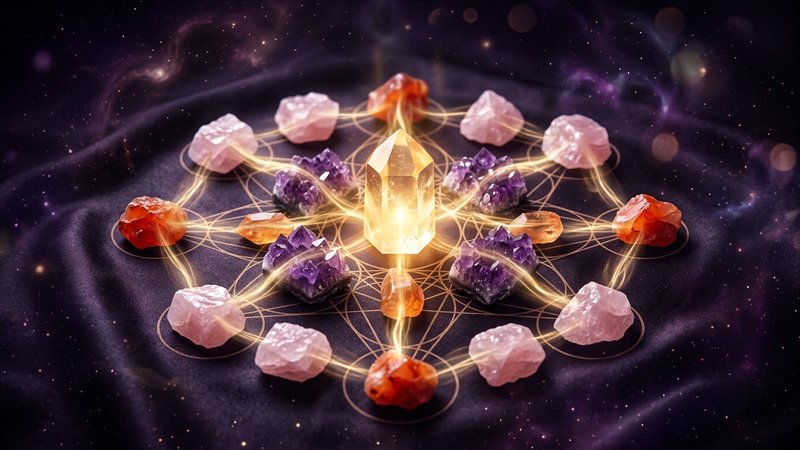
Reiki stones are crystals used alongside Reiki practice, most commonly clear quartz, amethyst, rose quartz, black tourmaline, citrine and colour-matched chakra sets. Practitioners use them to hold attention during sessions, to mark out a treatment space, and as focus objects in personal meditation.
The important thing to know first: crystals are not part of the original Usui system. They were added by modern practitioners, and a great many Reiki practitioners never use them at all.
This guide covers where crystals fit in relation to traditional Reiki, which stones are most commonly used and why, how a crystal grid works, how practitioners cleanse and recharge their stones, and the mistakes that show up most often.
Throughout, crystals are treated as symbolic tools. They hold attention and mark intention. They do not treat, cure or manage any condition, and neither does Reiki.
Are Crystals Part of Traditional Reiki?
No, and this is worth stating clearly because a lot of content blurs it.
Mikao Usui’s system as it was originally taught centres on attunement, hand positions, the precepts and daily self-practice. Crystals do not appear in that core. Japanese traditional lineages generally place little or no emphasis on them.
Crystal work entered Reiki through modern Western practice, where practitioners drew on separate crystal healing traditions and combined the two. That combination is now widespread, particularly at advanced levels, but it remains an addition rather than an original element.
What this means practically:
- Reiki is complete without crystals
- a practitioner who never uses them is not practising incompletely
- schools differ on whether crystal work is taught at all
- crystal knowledge is a separate body of tradition with its own history
Knowing the distinction lets you evaluate what a course is actually offering, and our guide to the Reiki symbols and what they represent covers the elements that do belong to the core system.
Why Practitioners Combine Reiki and Crystals
Four reasons come up consistently among practitioners who do use them.
Focus. A stone gives attention something to rest on, in the same way a mala or a breath count does. This is the most commonly cited reason and the most defensible.
Marking the space. Stones placed around a treatment area create a defined setting, which helps both practitioner and client shift into the session.
Consistency. Using the same objects each time builds a familiar ritual, and familiar ritual helps people settle faster.
Structure for chakra work. Colour-matched stones give a practitioner a clear map of where to place attention when working with the traditional energy centres.
Notice that all four are about attention and setting rather than about the stones acting on anything. That is the honest account, and experienced practitioners generally describe it that way themselves.
Common Reiki Crystals
Clear quartz. The most widely used stone in Reiki practice. Durable, easy to identify, inexpensive, and traditionally associated with clarity. Often used as a general-purpose focus object and placed at the centre of grids.
Amethyst. Associated with calm and reflection, and linked to the third eye and crown centres. Common in meditation practice and often kept in a treatment room. It fades in prolonged sunlight, so charge it in moonlight or brief early sun only.
Rose quartz. Associated with compassion and self-acceptance, and linked to the heart centre. Frequently used in sessions where a client is working through grief or a difficult period, held rather than placed.
Black tourmaline. Associated with grounding and boundaries. Often placed near the entrance of a treatment space, or used at the feet during a session to help someone settle.
Citrine. Associated with confidence and warmth, and linked to the solar plexus. Worth knowing that most deep amber citrine sold commercially is heat-treated amethyst rather than natural citrine, which is usually paler.
Chakra stone sets. Seven colour-matched stones covering the traditional centres from root to crown. These give a practitioner a consistent structure to work with, and many clients find the colour logic easy to follow. A seven-stone bracelet serves the same purpose in a wearable form, which suits daily practice better than a set kept in a pouch.
The Reiki Crystal Grid
A crystal grid is an arrangement of stones in a deliberate geometric pattern, usually around a treatment table or a central focal stone.
A common arrangement uses a larger central stone, often clear quartz, with smaller stones placed around it in a symmetrical layout. The practitioner sets an intention as the grid is laid out, and the grid stays in place for the session or for a set period.
What the tradition says: the arrangement is understood to hold and concentrate an intention, giving the practice a defined container.
What can be said without overclaiming: laying out a grid is a deliberate, attentive act that marks a beginning, and the finished arrangement is a visible reminder of what the session is for. There is no evidence that a geometric arrangement of minerals produces any physical effect, and grids should not be presented as though there were.
If you are new to the practice, a grid of three or five stones is more useful than an elaborate one. Complexity in the layout does not add anything except time.
Using Crystals During Meditation
Personal practice is where most practitioners develop their relationship with these stones, and it matters more than client work.
A simple ten-minute practice:
- Choose one stone and hold it in your palm.
- Breathe slowly for two minutes, attention on its weight and temperature.
- Bring to mind the quality you are working with.
- Sit quietly for the remaining minutes, returning to the stone when attention drifts.
- Close by setting the stone down deliberately.
Working with a single stone for several weeks teaches considerably more than rotating through a collection. The familiarity is part of what makes the object useful at all.
Crystals and Chakras
The colour correspondence is the usual framework:
| Chakra | Colour | Commonly Used Stones |
|---|---|---|
| Root | Red, black | Red jasper, black tourmaline, hematite |
| Sacral | Orange | Carnelian, orange calcite |
| Solar plexus | Yellow | Citrine, tiger’s eye |
| Heart | Green, pink | Green aventurine, rose quartz |
| Throat | Blue | Blue lace agate, sodalite |
| Third eye | Indigo | Amethyst, lapis lazuli |
| Crown | Violet, white, clear | Clear quartz, amethyst, selenite |
In a session, stones may be placed at the corresponding positions on or beside a reclining client, usually for fifteen to twenty minutes. Many practitioners prefer to place two or three rather than a full set, since a client covered in stones tends to become aware of the stones rather than settling.
Two cautions. Some stones are soft, sharp or water-sensitive, so check before placing anything directly on skin. And never place stones on anyone without explaining beforehand and getting their agreement.
How Practitioners Cleanse Their Crystals
Cleansing is the traditional practice of clearing a stone before setting a fresh intention. Practitioners who use crystals in client work generally cleanse more often than those who use them only personally.
Safe methods:
- Smoke from incense, dhoop, camphor or sage
- Sound from a bell, ghanti or singing bowl
- Selenite or clear quartz, resting smaller stones on a larger piece overnight
- Dry salt placed beside, not in contact with, the stones
- Earth contact for a few hours
Water cautions that matter: never soak selenite, which is water-soluble. Avoid water for hematite, which rusts, and for porous stones including turquoise, howlite and lapis lazuli. Avoid water entirely for elastic-strung bracelets, since it degrades the cord.
Monthly is a reasonable rhythm, plus after an emotionally heavy session or a period when many people have handled the stones. The full method, including bracelet-specific guidance, is in our guide to caring for crystal bracelets.
How to Recharge Crystals
Recharging is the second half of the ritual: restating the purpose after clearing.
- Moonlight, traditionally on the full moon. Our full moon charging ritual sets out the sequence step by step.
- Brief early morning sunlight, no more than an hour, and not for amethyst, rose quartz, citrine or fluorite, which fade.
- Earth contact, resting stones on soil for a few hours.
- Spoken intention, holding the stone and naming clearly what it is for.
The ritual has real value as punctuation. It marks the close of one period and the start of another, which helps a practitioner notice whether their own intention has shifted.
Reiki Level 3 and Crystal Work
In our teaching, crystal work belongs at Level 3 rather than earlier, and the reasoning matters.
Levels 1 and 2 establish the foundations: self-practice, hand positions, the precepts, the first symbols and distance work. Introducing crystals before those are settled tends to produce practitioners reaching for objects instead of developing attention.
By Level 3 the emphasis shifts from technique towards depth and presence, and crystal work sits naturally alongside Master symbol practice at that stage. Our Level 3 course covers the two together for exactly this reason.
It is worth repeating that this is a teaching choice rather than a universal rule. Other schools introduce crystals earlier, later or not at all, and none of those positions is wrong. What matters is that a school can explain why it does what it does.
Common Mistakes
Treating crystals as the practice. Reiki is the practice. Crystals support it. A practitioner whose sessions depend on their stones has usually skipped something more basic.
Using too many. Three stones used attentively beats a full layout used mechanically. Clients covered in stones notice the stones.
Claiming effects. Saying a crystal focuses attention is honest. Saying it clears blockages, treats conditions or protects someone from harm is not, and it is the fastest route to losing a client’s trust deservedly.
Placing stones without consent. Always explain and ask first, every session.
Ignoring physical care. Soaking selenite destroys it. Leaving amethyst in the sun fades it. Sharp raw stones cut skin. These are practical matters, not spiritual ones.
Buying without asking. Dyed howlite sold as turquoise, and dyed quartz standing in for several stones, are both common. A reputable seller will tell you what is natural, dyed or reconstituted.
Neglecting personal practice. Crystals in a treatment room do not compensate for a practitioner who has stopped practising daily.
Frequently Asked Questions
Are crystals part of traditional Reiki?
No. Usui’s original system centres on attunement, hand positions, the precepts and daily self-practice. Crystal work was added by modern Western practitioners drawing on separate crystal traditions. It is now widespread, particularly at advanced levels, but Reiki is complete without it and many practitioners never use stones.
What crystals are used in Reiki?
The most common are clear quartz for general focus, amethyst for calm and reflection, rose quartz for compassion, black tourmaline for grounding, citrine for confidence, and seven-stone chakra sets matched by colour to the traditional energy centres. Most practitioners work with a small number rather than a large collection.
What is a Reiki crystal grid?
An arrangement of stones in a deliberate geometric pattern, often around a treatment table with a larger central stone. The practitioner sets an intention while laying it out. Within the tradition it is understood to hold that intention. There is no evidence that the arrangement produces any physical effect.
How do Reiki practitioners cleanse their crystals?
Using smoke from incense or camphor, sound from a bell or singing bowl, resting smaller stones on selenite overnight, dry salt placed nearby, or earth contact. Avoid water for selenite, which dissolves, for hematite, which rusts, and for porous stones. Monthly is a reasonable rhythm for stones used with clients.
Do you need crystals to practise Reiki?
No. Reiki requires attunement, hand positions and daily practice, none of which involve stones. Crystals are an optional support that some practitioners find helpful for focus and for structuring chakra work. A practitioner who never uses them is not practising incompletely.
At what Reiki level are crystals taught?
It varies by school. In our teaching, crystal work belongs at Level 3, once self-practice, hand positions, symbols and distance work are established, so that students develop attention before reaching for objects. Other schools introduce crystals earlier or not at all, which is a legitimate difference rather than an error.
Can Reiki crystals heal illness?
No. Neither Reiki nor crystals treat, cure or manage any medical or psychological condition, and neither should ever delay or replace care from a qualified doctor. Their honest function is supporting attention and marking intention within a relaxation and spiritual practice.
Bringing It Together
Reiki stones are useful in the same way a good treatment room or a consistent opening ritual is useful. They help attention settle and give a session a defined shape. They are not the source of anything, and the practitioners who use them best tend to use the fewest.
Learn the core practice first, add crystals later if they genuinely help you, take proper care of them, and keep your claims about them small.
At The Golden Lotus, crystal work is taught where it belongs, alongside Master symbol practice, once the foundations are settled. If that stage of study interests you, our Reiki Level 3 training covers both together, and questions about course content are always welcome beforehand.
Have Questions About This Practice?
Whether you want to learn Reiki, explore Mesmerism, or book a 1-on-1 private energy alignment session, we welcome your questions.