
Most people can describe what they do not want far more easily than what they do. The wish is usually something like more money, a better job, some peace. Those are moods, not goals, and moods are difficult to act on.
A vision board turns that vagueness into something you can see. Knowing how to make a vision board is really about knowing how to get specific, because the board is only as useful as the clarity behind it.
This guide covers what a vision board is, how it relates to manifestation practice, the step-by-step process, the main categories to include, physical versus digital formats, the mistakes worth avoiding, and a five-minute daily practice.
The framework throughout is straightforward:
Vision → Intention → Awareness → Action → Reflection
Nothing here promises financial results. A vision board is a clarity tool, and the outcomes belong to the decisions you make afterwards.
What Is a Vision Board?
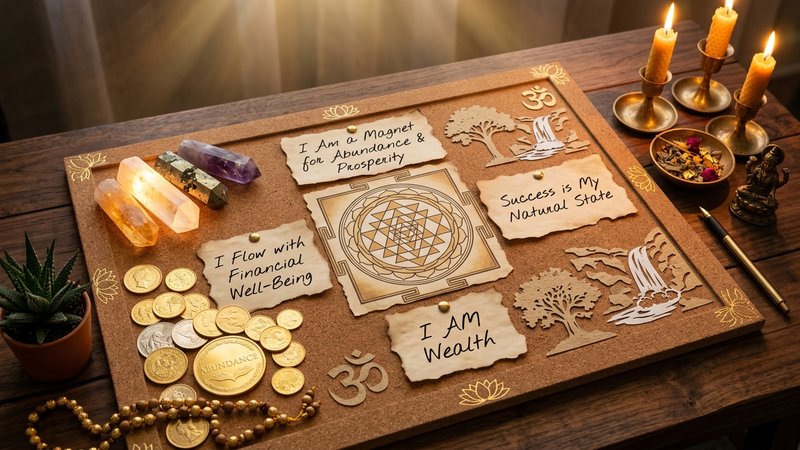
A vision board is a visual arrangement of the goals, experiences and qualities you want in your life, collected on a single surface you look at regularly.
It typically combines:
- images representing goals or a desired way of living
- written goals, stated specifically
- short quotes or affirmations
- personal or spiritual symbols
Two formats are common. A physical board uses chart paper, a corkboard or canvas with printed images and handwritten notes. A digital board is built in Canva, Pinterest or a slide, and often set as a phone or laptop wallpaper.
The essential feature is not the materials. It is that the board is seen often, by you, deliberately.
Why People Use Vision Boards
Three reasons account for most of it.
To make goals visible. A goal written once in a notebook is quickly forgotten. A goal on a wall is encountered daily, and repeated encounters keep it live.
To connect emotionally. Images produce a response that lists do not. That response is what sustains effort through the unglamorous middle of any project.
To create a focal point for practice. For people with a meditation, prayer or reflection habit, the board gives that practice something specific to rest on.
None of these requires any belief about attraction or energy. They are ordinary functions of attention, which is what makes vision boards useful to sceptics and spiritual practitioners alike.
Vision Boards and Goal Clarity
The clarifying work happens while you build the board, not while you look at it.
To place something on a board, you have to decide what it is. Vague wishes resist that. You cannot select an image for I want things to improve, but you can for I want to move to a two-bedroom place by next Diwali.
That forced specificity is the real value, and it is why building a board slowly serves better than finishing it in one evening. Sit with each item long enough to ask whether it is actually what you want, or whether it is what you think you should want.
A practical test for each item: could you describe to someone else exactly what achieving it would look like? If not, it needs more thought before it goes on the board.
Vision Board vs Manifestation
These two get conflated, and separating them keeps expectations honest.
A vision board is a clarity and focus tool. It holds your goals where you can see them.
Manifestation, as commonly practised, is a broader set of beliefs and practices about aligning intention with outcome.
A vision board can support a manifestation practice, and many people use it that way. It can equally be used as a plain goal-setting tool with no spiritual framing at all, and it works the same in both cases.
What should be said clearly: no vision board causes money, opportunities or relationships to arrive. What it can do is keep your attention on what matters, which affects what you notice and what you choose. Opportunities still arrive as decisions requiring effort and risk.
The sequence at the top of this guide is deliberately five steps rather than two. Vision and intention are where the board does its work. Awareness, action and reflection are where you do yours.
How to Make a Vision Board Step by Step
Step 1: Decide What Abundance Means to You
Before any images, define the target. Abundance is not only money. For most people it includes some combination of financial stability, meaningful relationships, health, career growth, freedom over their time, spiritual practice, family and peace of mind.
Write your own definition in two sentences. Every item on the board should trace back to it.
This step prevents the most common failure, which is a board full of things that photograph well and mean nothing to you.
Step 2: Set Clear Intentions
Turn each desire into a statement specific enough to picture.
Instead of: I want more money.
Try: I want to build a stable income that lets me save consistently and cover six months of expenses.
Instead of: I want to grow spiritually.
Try: I want a daily practice I actually keep, and one course completed this year.
The second version of each can be acted on tomorrow. The first cannot.
Step 3: Choose Your Categories
Pick four to six categories rather than all of them. A focused board is more useful than a comprehensive one.
The main categories:
- Money: savings, investments, income, financial security
- Career: role, business milestones, skills, recognition
- Relationships: partnership, friendship, honest communication
- Health: fitness, food, rest, energy
- Spiritual growth: practice, study, stillness, service
- Travel: places, pilgrimages, experiences
- Home: the space you want to live in
- Contribution: giving, teaching, the difference you want to make
Step 4: Collect Images and Words
Gather more than you need, then select.
Sources include printed photographs, magazine cut-outs, your own pictures, handwritten words, and downloaded images for a digital board.
The selection rule that matters: choose images that produce a genuine response. A polished stock photo you feel nothing about is decoration. A slightly poor photograph of the exact place, work or moment you want is fuel.
Where an image would be vague, write the goal in words instead. A clearly written number often does more than a picture.
Step 5: Add Affirmations
A few short statements reinforce the mindset behind the goals. Keep them believable, because a statement you privately disagree with tends to invite the opposite thought.
Examples:
- I am building income steadily through work I can improve at.
- I handle money with awareness and responsibility.
- I notice opportunities and act on them promptly.
- I am grateful for what I have while I work towards more.
- I make decisions from clarity rather than fear.
- I give within my means and receive without guilt.
Three or four is plenty. This is a vision board, not an affirmation wall.
Step 6: Arrange the Board
Layout affects how the board reads at a glance.
- Put the most important goals near the centre, where the eye lands first.
- Group items by category.
- Leave space. An overcrowded board becomes clutter you stop seeing.
- Keep written goals large enough to read from where you will stand.
Step 7: Put It Somewhere Visible
Suitable placements: a bedroom wall you see on waking, a desk or workspace, a study, a meditation corner, or a phone and laptop wallpaper for digital boards.
If you would rather keep your goals private, that is entirely fine. Inside a wardrobe door, in a journal, or in a private folder on your phone all work. Visibility to you is what matters.
Step 8: Review It Regularly
A short daily look, plus a longer monthly review. During the monthly review, check what has moved, what has not, and whether any goal has quietly stopped being something you want.
Completed goals should be marked rather than simply removed. Seeing your own history of finished intentions is the most persuasive evidence a board ever produces.
Physical vs Digital Vision Board
| Factor | Physical Board | Digital Board |
|---|---|---|
| Ease of creation | Slower, involves printing and arranging | Quick to build and restyle |
| Visibility | Always present in the room | Visible when you open the device or set it as wallpaper |
| Customisation | Tactile, handwritten, layered | Easy to edit and duplicate |
| Portability | Stays in one place | Travels with you |
| Emotional connection | Usually stronger, since you handle every element | Depends how personal the images are |
| Best for | People who respond to tangible reminders | People who travel, rent, or live mostly on devices |
Neither is better. The right one is whichever you will actually look at. Many people keep both: a physical board at home and a digital version on the phone.
Common Mistakes
Using other people’s goals. A board built around family or social expectations produces resistance every time you look at it.
Too many unrelated items. Twenty scattered goals dilute focus. Choose fewer and go deeper.
Only material possessions. Objects alone rarely sustain motivation for long. Include relationships, health, practice and purpose.
Building it and forgetting it. A board you have stopped noticing has stopped working.
Expecting results without action. Clarity helps you recognise opportunities. Effort is what converts them.
Vague goals. Success and happiness cannot be acted on. Define what they mean for you.
Changing goals constantly. Give an intention several months before replacing it.
Treating it as a financial plan. A board is not a budget, an investment strategy or a substitute for qualified advice.
A Five-Minute Daily Practice
Once a day, ideally in the morning:
- Look at the board without rushing.
- Take three slow breaths.
- Focus on the one goal that matters most right now.
- Imagine what achieving it would actually feel like.
- Say thank you for something you already have.
- Choose one small action for today, and do it.
Step six is the one people skip and the one that moves things. Five minutes daily does considerably more than an hour once a month.
Many people pair this with a short evening reflection instead, since attention settles more easily before sleep. Our guide to working with subconscious patterns before sleep covers that timing in detail, and the wider relationship between attention, body and inner steadiness is explored in our writing on integrated mind and body practice.
For those who like a symbolic anchor alongside the board, the Maha Lakshmi bracelet is worn in Indian tradition as a reminder of prosperity in its fuller sense, meaning dignity and sufficiency rather than money alone. It is a symbol of an intention you are working towards, not a mechanism that produces one.
Frequently Asked Questions
How do I make a vision board?
Define what abundance means to you, turn each desire into a specific intention, choose four to six categories, collect images and written goals that produce a genuine response, add a few believable affirmations, arrange it with the most important items near the centre, and place it where you will see it daily.
What should I put on a vision board?
Images, written goals, short affirmations and personal symbols across the categories that matter to you now, typically money, career, relationships, health, spiritual growth, travel, home or contribution. Choose items with emotional meaning rather than ones that simply look attractive, and write goals out where an image would be vague.
What are the main vision board categories?
The commonly used categories are money and finances, career and business, relationships, health and wellbeing, spiritual growth, travel and experiences, home and lifestyle, and contribution or purpose. Select four to six that reflect your current priorities rather than trying to cover all of them at once.
Does a vision board really work?
It works as a clarity and focus tool, not as a cause of outcomes. Building it forces you to get specific, and seeing it daily keeps your goals in view, which affects what you notice and choose. Results depend on the decisions and effort that follow, never on the board itself.
Can I make a vision board on my phone?
Yes. Build it in Canva, Pinterest or any collage app and set it as your lock screen or wallpaper. Digital boards are quick to create, easy to update and travel with you. The one trade-off is that they are easier to scroll past without really looking.
How often should I update my vision board?
There is no fixed rule. A short daily look plus a fuller monthly review works well, with a complete rebuild yearly or after a significant life change. When a goal is achieved, mark it rather than simply deleting it, since a record of finished intentions is genuinely motivating.
Can I include money goals on my vision board?
Absolutely, and specific numbers work better than general wishes for wealth. A savings target with a date, an emergency fund, a debt-free milestone or an income goal can all be pictured and planned for. Keep in mind that a board is not a financial plan and does not replace qualified advice.
Bringing It Together
A vision board is a small, visible commitment to being specific about what you want. Vision gives it shape, intention makes it actionable, awareness helps you notice what is relevant, action moves it, and reflection keeps it honest.
Build it slowly, keep it focused, look at it daily, and let each look end with one small thing done.
At The Golden Lotus, we believe personal transformation begins with awareness, intention and conscious action, in that order. If you would like to go further into inner clarity and energy awareness than a board alone allows, our programmes and guided study are a considered next step, and questions about which one suits you are always welcome.

Have Questions About This Practice?
Whether you want to learn Reiki, explore Mesmerism, or book a 1-on-1 private energy alignment session, we welcome your questions.