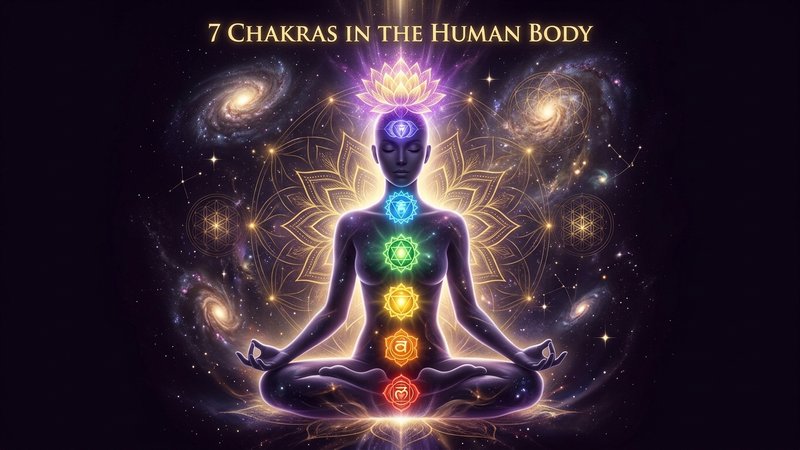
The seven chakras in the human body, as described in yogic tradition, run along the line of the spine from its base to the crown of the head: Muladhara at the base, Svadhisthana below the navel, Manipura at the solar plexus, Anahata at the heart, Vishuddha at the throat, Ajna between the eyebrows, and Sahasrara at the crown.
Each is associated with a colour, an element, a seed sound and a set of human themes, from physical security at the root to spiritual awareness at the crown.
An important framing before we go further. Chakras belong to traditional yogic and tantric spiritual frameworks. They are not physical organs, and they are not structures identified by anatomy or physiology. They are a map of inner experience, and they have been used as one for well over a thousand years. Read this guide in that spirit and it becomes genuinely useful. Read it as biology and it will mislead you.
What Are Chakras?
The Sanskrit word chakra means wheel or disc. In yogic and tantric texts, chakras are described as centres within the subtle body, a framework of energy channels called nadis through which prana, the vital breath, is said to move.
The subtle body is not the physical body. Classical texts are explicit about this. The chakras are described as being located along the sushumna, the central channel associated with the spine, but they are understood as centres of experience rather than objects that could be dissected.
Each chakra is traditionally described with:
- a Sanskrit name
- a position along the central channel
- a number of petals, which relate to the Sanskrit alphabet
- a bija or seed mantra
- an element, in the lower five
- a cluster of human themes and qualities
Used well, the system is a vocabulary for self-observation. It gives shape to states that are otherwise hard to name: the difference between feeling unsafe and feeling unheard, between creative flatness and lack of confidence.
Where Does the Seven-Chakra System Come From?
The roots go deep, but the version most people know today is younger than it appears.
References to centres within the subtle body appear in the Upanishads and develop substantially through tantric literature between roughly the eighth and fifteenth centuries. Different texts describe different systems. Some list five centres, some six, some more. The number seven is one tradition among several rather than a universal fact.
The seven-chakra model familiar in the modern world draws largely on one sixteenth-century Sanskrit text, the Sat-Chakra-Nirupana, which reached English readers through an early twentieth-century translation. From there it passed into Theosophical writing and then into twentieth-century Western spirituality.
The rainbow colour scheme is the clearest example of how much has been added along the way. Classical descriptions assign colours to petals and elements, and they do not correspond neatly to the red-to-violet spectrum used today. That mapping is modern.
None of this diminishes the system. It does mean that when sources disagree, they may simply be drawing on different traditions, and that is worth knowing before you conclude someone is wrong.
The Seven Chakras: Overview Table
| Chakra | Sanskrit Name | Location | Colour | Element | Traditional Association |
|---|---|---|---|---|---|
| Root | Muladhara | Base of the spine | Red | Earth | Safety, survival, grounding, belonging |
| Sacral | Svadhisthana | Below the navel | Orange | Water | Creativity, emotion, pleasure, flow |
| Solar Plexus | Manipura | Above the navel | Yellow | Fire | Willpower, confidence, personal authority |
| Heart | Anahata | Centre of the chest | Green | Air | Love, compassion, connection, forgiveness |
| Throat | Vishuddha | Throat | Blue | Ether or space | Expression, truth, communication |
| Third Eye | Ajna | Between the eyebrows | Indigo | Light or mind | Intuition, perception, clarity |
| Crown | Sahasrara | Top of the head | Violet or white | Pure consciousness | Awareness, stillness, spiritual connection |
Root Chakra: Muladhara
Location: base of the spine. Colour: red. Element: earth. Seed sound: LAM. Petals: four.
The root chakra is associated with the most fundamental questions a person faces: am I safe, do I have enough, do I belong here. Its themes are physical security, housing, money, family and the body itself.
In traditional description it is the foundation. The word muladhara itself combines root and support. The teaching is that the centres above it cannot settle while the base is unsteady, which is why practice usually begins here.
Commonly associated themes when the root feels unsettled: restlessness, a sense of not being able to relax, preoccupation with security, difficulty feeling at home anywhere.
Practices traditionally associated with it include walking, contact with the ground, physical routine, and stabilising breathwork.
Sacral Chakra: Svadhisthana
Location: below the navel. Colour: orange. Element: water. Seed sound: VAM. Petals: six.
The sacral chakra is associated with movement, feeling and creativity. Where the root is about standing still safely, the sacral is about flow: emotions that move rather than freeze, creative work, enjoyment, and relationship.
Its element is water, and the imagery follows: what is healthy here is fluid, and what is difficult is either frozen or flooding.
Traditional themes include creative expression, emotional responsiveness, the capacity for pleasure, and the ability to adapt.
Solar Plexus Chakra: Manipura
Location: above the navel. Colour: yellow. Element: fire. Seed sound: RAM. Petals: ten.
Manipura translates as city of jewels. It is associated with will, decision-making, confidence and the capacity to act on your own behalf.
Fire is the element, which captures both sides of it. Too little and there is no initiative. Too much and there is force without listening. The traditional aim is warmth rather than heat.
Themes commonly associated with this centre: self-assurance, the ability to set direction, follow-through, and how you handle being challenged.
Heart Chakra: Anahata
Location: centre of the chest. Colour: green. Element: air. Seed sound: YAM. Petals: twelve.
Anahata means unstruck, referring to a sound produced without two things striking together. It sits at the middle of the system, and traditionally it is the meeting point between the three lower centres, concerned with the material and personal, and the three upper ones, concerned with expression and awareness.
Its themes are love, compassion, connection, grief and forgiveness, directed both outward and inward. Many practitioners regard self-compassion as heart chakra work just as much as love for others.
The heart is where most people begin, because these are the themes they feel most immediately.
Throat Chakra: Vishuddha
Location: throat. Colour: blue. Element: ether or space. Seed sound: HAM. Petals: sixteen.
Vishuddha means purification. It is associated with expression, truthfulness and the capacity to say what is actually so.
Its themes go beyond speaking. They include listening, knowing when not to speak, creative expression in any form, and the gap between what someone feels and what they are able to communicate.
Traditional practices include chanting, mantra, singing and recitation, all of which involve the voice directly.
Third Eye Chakra: Ajna
Location: between the eyebrows. Colour: indigo. Seed sound: OM. Petals: two.
Ajna means command or perceive. It is associated with insight, discernment and perception that goes beyond the senses.
The two petals are significant in traditional description, often read as the meeting of two channels, ida and pingala, at this point. Where the lower centres each carry an element, Ajna is generally associated with mind or light rather than a material element.
Themes include clarity of thought, intuition, imagination, and the ability to see a situation whole rather than in fragments.
A word of caution that experienced teachers repeat. Intense focus on third eye practice, without grounding, unsettles some practitioners. Traditional sequencing begins at the base for good reason.
Crown Chakra: Sahasrara
Location: top of the head. Colour: violet or white. Seed sound: silence in many traditions. Petals: one thousand.
Sahasrara means thousand-petalled. It is associated with awareness itself, with stillness, and with the dissolving of the sense of separateness.
In classical description it is less a centre to be worked on than a state arrived at, the culmination of the system rather than one more item in a list. Practices associated with it are quiet rather than active: sitting, silence, surrender.
Modern chakra practice tends to treat all seven as equivalent stations to be balanced in sequence. Classical sources treat the crown quite differently, and the distinction is worth knowing.
Chakra Colours and Symbolism
The modern colour sequence runs red, orange, yellow, green, blue, indigo, violet, from root to crown.
Its appeal is obvious. It is memorable, it maps to the visible spectrum, and it makes teaching straightforward. It is also modern, and classical texts describe colours quite differently, often assigning them to petals, elements or associated deities rather than to the centre as a whole.
What the colours are useful for:
- remembering the sequence
- choosing symbolic objects, cloth or chakra jewellery for practice
- visualization, where a colour gives the mind something to hold
- teaching beginners a system they can retain
What they are not: a traditional given, or something to treat as fixed. If a colour does not work for you in visualization, use one that does.
What People Mean by “Blocked Chakras”
The phrase is used loosely, and it helps to unpack it.
In spiritual terms, a blocked chakra describes a centre where energy is said not to move freely, leaving its associated themes stuck. In ordinary terms, people usually mean they recognise a pattern: they cannot settle, they cannot speak up, they cannot feel much, they cannot decide.
Two cautions worth holding.
First, this language is descriptive, not diagnostic. A blocked chakra is not a medical finding, and nobody can detect one in a way that could be verified.
Second, be wary of anyone who tells you your chakras are blocked and offers to fix them for a fee, particularly if the claim arrives with urgency or fear. Responsible practitioners describe patterns and offer practices. They do not diagnose and they do not frighten.
If you want a practical starting point rather than theory, our guide to clearing and balancing the energy centres sets out routines for each of the seven.
Signs Traditionally Associated With Imbalance
These are traditional associations within spiritual practice, offered as a vocabulary for self-reflection. They are not symptoms, and they do not indicate any medical or psychological condition.
- Root: restlessness, insecurity, difficulty feeling settled
- Sacral: creative flatness, emotional numbness or volatility
- Solar plexus: indecision, difficulty asserting yourself, or forcefulness
- Heart: difficulty giving or receiving warmth, holding on to resentment
- Throat: not saying what you mean, or speaking without listening
- Third eye: confusion, difficulty seeing a situation clearly
- Crown: disconnection, a sense that nothing has meaning
If any of these describes something persistent and distressing, particularly ongoing low mood, anxiety or a sense of disconnection from reality, please speak to a doctor or qualified mental health professional. These are health matters. Framing them as energy problems delays care that people need.
Ways People Practise Chakra Awareness
Four approaches are most common, and they combine well.
Meditation
Attention is moved through the centres in sequence, usually from root to crown, resting at each for a few breaths. Most people find a short daily practice more useful than a long weekly one. Ten minutes is a reasonable starting length.
A simple version: sit comfortably, bring attention to the base of the spine for five slow breaths, then move upward through each centre in turn, finishing with a minute of open attention at the crown.
Breathwork
Breath is the traditional bridge between body and attention. Slow diaphragmatic breathing suits the lower centres, where the aim is steadiness. Longer exhalations tend to settle agitation. Voice-based practices, chanting and mantra, are traditionally associated with the throat.
Keep breathwork gentle. Intensive techniques such as prolonged retention should be learned with a teacher, and are not suitable during pregnancy or with heart conditions, high blood pressure, epilepsy or certain respiratory conditions.
Reiki and Energy Practices
In Reiki, hand positions frequently correspond to the chakra locations, and many practitioners work with the system as a framework for where to place attention during a session. Chakra awareness is often introduced early in training for this reason, and our Reiki Level 1 and 2 course covers it alongside the foundational hand positions.
For those who would rather receive than learn first, a guided chakra balancing consultation offers a structured introduction with a practitioner.
Crystals and Symbolic Tools
Stones are matched to the centres by colour: red jasper at the root, carnelian at the sacral, citrine at the solar plexus, green aventurine or rose quartz at the heart, blue lace agate at the throat, lapis lazuli or amethyst at the third eye, clear quartz at the crown.
Be clear about their role. Crystals are symbolic focus objects, not devices. Their usefulness is in holding attention and marking intention, which is a real function and does not require any claim beyond it.
The relationship between physical state and inner state runs both ways, and we explore that further in our writing on holistic mind and body practice.
Frequently Asked Questions
What are the 7 chakras in the human body?
The seven chakras are Muladhara at the base of the spine, Svadhisthana below the navel, Manipura at the solar plexus, Anahata at the centre of the chest, Vishuddha at the throat, Ajna between the eyebrows, and Sahasrara at the crown. Each is associated with a colour, an element and a set of human themes.
Are chakras scientifically proven?
No. Chakras belong to traditional yogic and tantric spiritual frameworks and describe the subtle body rather than physical anatomy. They have not been identified by physiology, and no chakra assessment can be verified. They are best understood as a map for self-reflection and practice rather than as biological structures.
What are the seven chakra colours in order?
From root to crown: red, orange, yellow, green, blue, indigo and violet or white. This rainbow sequence is a modern convention rather than a classical one. Traditional Sanskrit texts describe colours differently, often assigning them to petals, elements or associated forms rather than to the centre as a whole.
Where is each chakra located in the body?
Along the line of the spine: root at its base, sacral below the navel, solar plexus above the navel, heart at the centre of the chest, throat at the throat, third eye between the eyebrows, and crown at the top of the head. These are positions in the subtle body rather than anatomical locations.
What does a blocked chakra mean?
In spiritual terms it describes a centre where energy is said not to move freely, leaving its themes stuck. In practice people usually mean they recognise a pattern such as feeling unsettled or unable to speak up. It is not a medical diagnosis and cannot be detected or verified.
How do you balance your chakras?
Common practices include meditation moving attention through each centre, gentle breathwork, chanting or mantra for the throat, Reiki and other energy practices, and symbolic aids such as colour-matched crystals. Balance in this context means attention and regular practice, not a fixed state to be achieved and completed.
How long does chakra practice take to have an effect?
Most people notice changes in attention and steadiness within a few weeks of short daily practice. Deeper shifts take longer and rarely move in a straight line. Consistency matters more than session length, so ten minutes daily generally serves better than an hour once a week.
Bringing It Together
The seven chakras offer something genuinely valuable: a vocabulary for parts of experience that are otherwise difficult to name, and a sequence that begins with the practical and moves towards the reflective.
Take the tradition seriously enough to learn where it came from, hold the modern additions lightly, and keep the claims honest. It is a map for practice, not a description of the body.
At The Golden Lotus, chakra awareness runs through everything we teach, from foundational Reiki training onwards. If you would like guided support rather than working alone, our personal energy healing sessions are a considered place to begin, and questions about what a session involves are always welcome beforehand.
Have Questions About This Practice?
Whether you want to learn Reiki, explore Mesmerism, or book a 1-on-1 private energy alignment session, we welcome your questions.