
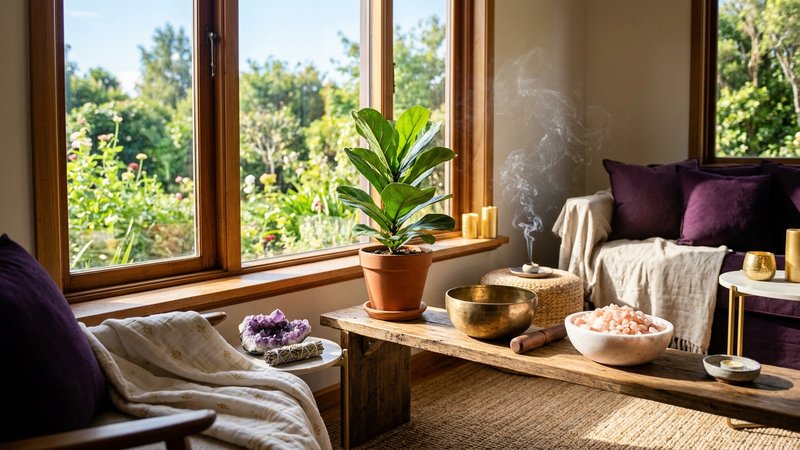
Spiritual cleansing at home means deliberately resetting the atmosphere of a space using practices such as cleaning, opening windows, sound, incense, prayer, intention and visualization. Most traditions combine a physical reset with a symbolic one, and the combination is what people actually feel.
This guide walks through a complete home energy cleansing routine, in the order that works best: clear the clutter, let in air and light, then move through the symbolic practices that suit your own tradition.
It also takes a grounded position. When a house feels heavy, the cause is usually something ordinary and fixable: poor ventilation, clutter, bad lighting, noise, disturbed sleep, or unresolved tension between people who live there. Address those first. The spiritual layer works better on a foundation that is already sound, and nothing in this guide suggests that ordinary events are evidence of spirits or entities in your home.
What People Mean by “Negative Energy”
The phrase covers a wide range of experiences. When people say a room feels heavy, they usually mean one of these:
- the space feels stale, stuffy or airless
- there has been recent conflict, illness, grief or stress in the house
- the room is cluttered, dark or poorly lit
- they have been sleeping badly or working long hours in the same room
- a guest or a difficult period left an association they have not shaken off
These are real perceptions. A room genuinely affects mood, focus and sleep. The word “energy” is shorthand for the overall quality of a space, and used that way it is perfectly reasonable.
Spiritual Interpretation vs Ordinary Environmental Causes
Two ways of reading a heavy atmosphere, and both deserve respect.
The environmental reading. Air quality, light, temperature, noise, clutter and smell all measurably affect how people feel in a room, as does whatever has recently happened between the people living there. These are the causes you can verify and change.
The spiritual reading. Many traditions describe spaces as holding residue from emotion, illness or conflict, and prescribe rituals to clear it. That belongs to faith and practice rather than evidence.
Start with the first and layer the second on top. If your bedroom feels oppressive, opening the window and clearing the floor will do more than incense alone, and the incense will land better afterwards.
One boundary worth holding: an unfamiliar noise or a run of setbacks is not proof that something is present in your home, and nobody should be frightened into buying remedies for a house. Persistent fear or sleeplessness that is not improving is worth discussing with a doctor rather than treating as a spiritual emergency.
Step 1: Declutter and Clean First
This is the least mystical step and by far the most effective.
- Clear floors and surfaces. Visual chaos is the biggest single contributor to a room feeling wrong.
- Handle the pile everyone has, the one that has sat in the corner for months.
- Clean corners, under furniture and behind doors, where dust gathers unnoticed.
- Wash curtains, bedding and cushion covers. Fabric holds smell more than anything else.
- Remove broken items you have been meaning to fix. Broken things carry a quiet weight.
- Empty bins and clear the kitchen sink.
Do this before any ritual. In most homes the atmosphere shifts noticeably by the end of this step alone.
Step 2: Fresh Air and Sunlight
Open every window and external door you can, ideally on opposite sides of the home so air moves through rather than sitting still. Fifteen to twenty minutes is enough in most conditions.
Then let light in: draw curtains fully back during the day, clean the windows, change dim or flickering bulbs, and where a room gets no daylight, use warm lamps at several heights rather than one harsh overhead light.
Many traditions treat morning light as the most purifying, which lines up well with practical advice about light exposure and sleep rhythm.
Step 3: Meditation and Intention
Before any ritual, settle yourself. A cleansing performed while agitated tends to feel like a chore.
Five minutes is enough. Sit in the room that feels heaviest, breathe slowly with a longer exhale, name clearly what you want the space to feel like, and hold that image for a minute before you begin.
Intention is the thread connecting every step that follows. Without it, you are just walking around with incense.
Step 4: Sound Cleansing
Sound is one of the oldest and most practical cleansing methods, and it reaches corners that nothing else does.
Options: a bell or ghanti rung at each doorway and in the corners, a singing bowl carried slowly through the space, clapping in corners and behind doors, chanting or prayer in your own tradition, or calm instrumental music played through the whole home for an hour.
Move room by room rather than standing in one place, and pay attention to corners, cupboards and the spaces behind doors.
Step 5: Incense and Smudging Traditions
Most cultures have a smoke tradition. In Indian homes this is typically dhoop, agarbatti, camphor or sambrani. Elsewhere it may be sage, palo santo or frankincense.
A simple method:
- Start at the far corner of the home, furthest from the main door.
- Move clockwise through each room, keeping the smoke low and moving.
- Pass the smoke around doorways, windows and corners.
- Finish at the main entrance and let the last of the smoke leave through the open door.
Safety comes first here, and it is covered in full further down. Two notes worth making now: white sage has been heavily over-harvested and holds specific ceremonial meaning for particular Native American communities, so many practitioners prefer local traditional materials. And smoke is not appropriate in every home, particularly where someone has asthma or a respiratory condition. Sound, air and intention are complete practices on their own.
Step 6: Salt Practices
Salt appears in cleansing traditions almost everywhere, usually as an absorbing or protecting material.
Common practices: a small bowl of rock salt left in a corner and changed weekly, a pinch of salt in floor-cleaning water, a line of salt at a threshold, or salt water used to wipe surfaces.
Practical cautions: salt corrodes metal, damages some flooring and is harmful to pets if eaten. Keep bowls away from animals and small children, and off stone, wood and metal fittings.
Step 7: Prayer or Mantra According to Your Tradition
This step belongs to you rather than to any generic formula. Use the prayer, mantra or recitation of your own faith, said with attention rather than speed. In Indian homes that might be a Gayatri recitation, a Hanuman Chalisa or a diya lit at the household shrine. Elsewhere it may be a psalm, a dua or a moment of silence.
The consistent element across traditions is a deliberate act, done attentively, that marks a change in the space.
Step 8: Visualization
Visualization can be done alone or alongside any of the above.
Stand in the middle of the room with your eyes closed. Picture it filled with still, clean light, and imagine the heaviness drawn towards the open window and out. Then picture the room as you want it to feel, in specific detail, and open your eyes and look at the actual room.
That last step matters. It connects the image to reality and usually shows you one physical thing still to change.
Step 9: Crystals as Symbolic Tools
Crystals are used in home cleansing as markers and reminders rather than as devices.
Common placements: clear quartz or selenite in a main room for clarity, black tourmaline or hematite near the entrance for grounding, amethyst in a bedroom for calm, and rose quartz in shared space for warmth between people.
Be clear-eyed about it. No stone alters the air, the electromagnetic environment or anyone’s health. Their value is symbolic: a visible object reminding you what you decided this space is for. That is a real function, and it is enough. Crystals used at home should be cleansed periodically like any other, and our full moon charging guide covers the usual method. If you would like prepared pieces for the home, our crystal and spiritual product range is a starting point.
Step 10: Aura and Personal Cleansing
There is little point clearing a house while carrying the same state around inside it.
The usual elements: a shower taken with attention, ten minutes of slow breathing after coming home, a change of clothes on returning from a hospital or a funeral, and a short grounding practice with feet flat on the floor and three slow breaths.
Our detailed routines for this are in the guide to aura cleansing techniques at home.
Step 11: Energy Shielding
Shielding is about maintaining a boundary rather than clearing after the fact, and in practice it is mostly about limits: what you take in, who you spend draining hours with, how much conflict you consume before bed.
Symbolic practices such as visualizing a boundary of light before entering a difficult environment work as mental preparation. Not magic, but genuinely steadying, in the way a pre-match routine is. Our guide to energy shielding and protection methods covers the full set.
Step 12: Creating a Peaceful Home Routine
A single deep cleanse fades. Small routines hold.
Daily: open windows for ten minutes, clear surfaces before bed, light a diya or incense at a consistent time, and keep one corner reserved for stillness or prayer.
Weekly: a proper clean including corners and under furniture, fresh bedding, replaced salt bowls if you keep them, and one short sound or smoke cleanse.
Monthly: a full walkthrough using the steps above, one drawer or cupboard decluttered, and any crystals in the home cleansed and recharged.
The mind-body-energy connection works both ways: a settled home supports a settled state, and a settled state makes you keep the home that way. Our guide to mind-body-energy connection techniques goes into that relationship in more detail.
How Often Should You Cleanse Your Home?
There is no fixed rule. A light weekly reset of air, light and sound suits most homes, with a fuller monthly walkthrough using your chosen ritual. Beyond that, cleanse after specific events such as illness, an argument, a bereavement or a difficult visit, and at transitions such as moving in, Diwali, a new year or a renovation.
If you find yourself cleansing constantly and still feeling uneasy, treat that as information. Compulsive cleansing often points to anxiety that deserves attention in its own right, and talking to a doctor or someone you trust is the more useful step.
Safety Precautions: Smoke, Pets and Fire
Please read this section properly. Home cleansing causes real accidents every year.
Fire safety:
- never leave burning incense, camphor, charcoal or a diya unattended
- use a proper heat-resistant holder, not a plate or a piece of cloth
- keep flames away from curtains, paper, plastic and loose clothing
- extinguish everything fully before leaving the house or sleeping
- keep matches and lighters out of reach of children
Smoke and air quality:
- ventilate throughout, not only afterwards
- incense produces particulate matter, so keep sessions short in small rooms
- avoid smoke entirely around asthma, COPD, pregnancy and infants
- sound, air, light and intention are full alternatives
Pets:
- birds are extremely sensitive to smoke and should be moved to another room with fresh air, or the practice skipped
- cats and dogs should be able to leave the room freely
- keep salt bowls and essential oils away from animals, as several oils are toxic to cats and dogs
- keep loose crystals away from pets that chew
Finally, cleansing practices are never a substitute for medical care. If someone in the home is unwell, the priority is a doctor.
Frequently Asked Questions
How do I do spiritual cleansing at home?
Start by decluttering and cleaning, then open windows for fresh air and let in daylight. Settle yourself with a few minutes of breathing and set a clear intention. Then move room by room using sound, incense or prayer according to your tradition, finishing at the main door with it open.
How do I remove negative energy from my home?
Address the ordinary causes first: clutter, stale air, poor light, noise and unresolved tension between people. Then use a symbolic practice such as bell or singing bowl sound, incense or dhoop smoke, salt, prayer or visualization, working clockwise through each room and finishing at the entrance.
How often should I cleanse my house?
A light weekly reset of air, light and sound suits most homes, with a fuller monthly walkthrough. Additionally, cleanse after illness, conflict, bereavement, a difficult visit, or when moving into a new home. There is no fixed requirement, so choose a rhythm you can actually maintain.
Does burning incense actually remove negative energy?
Within spiritual traditions, smoke is understood to purify a space, and the ritual has genuine value as a deliberate act with a clear intention. Physically, incense adds particulate matter to indoor air rather than cleaning it, so ventilate well and keep sessions short. Fresh air remains the most effective physical reset.
Is salt effective for cleansing a home?
Salt appears as an absorbing or protecting material across many traditions, and small bowls of rock salt changed weekly are a common practice. Treat it as symbolic rather than functional. Keep salt away from pets, children, metal fittings and unsealed floors, since it corrodes and can be harmful if eaten.
What are the signs that a house needs energy cleansing?
People typically describe stale or heavy air, difficulty relaxing, disturbed sleep, or a room they avoid without knowing why. These usually have ordinary causes such as clutter, poor ventilation, bad lighting or recent tension in the household. An unsettled feeling is not evidence of spirits or entities.
Can I cleanse my home without smoke?
Yes, completely. Opening windows, cleaning, sound from a bell or singing bowl, prayer or mantra, visualization and intention form a full practice on their own. Smoke-free methods are the right choice in homes with asthma, respiratory conditions, infants, pregnancy or birds.
Bringing It Together
A home that feels good is mostly ordinary care done consistently: air, light, order and honest relationships between the people inside it. Ritual gives that care shape and rhythm, and marks the moments when you decide something needs to change.
Start with the physical reset, add the practice that belongs to your own tradition, and keep it safe, regular and honest.
At The Golden Lotus, we approach energy work as awareness and discipline rather than as something performed on a space and then forgotten. If you would like personal guidance for yourself rather than for your home, our energy healing consultation is a considered place to begin.
Have Questions About This Practice?
Whether you want to learn Reiki, explore Mesmerism, or book a 1-on-1 private energy alignment session, we welcome your questions.