
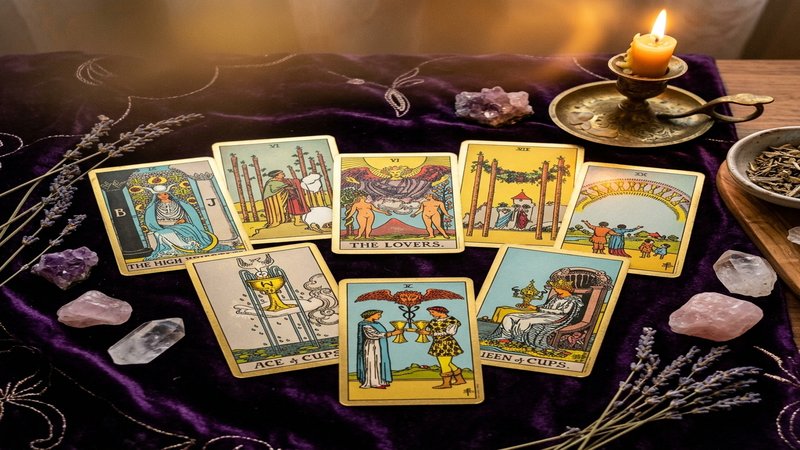
A tarot love spread is a defined layout of cards, each position assigned a specific meaning, used to look at a relationship from several angles at once. The simplest use three cards. The most detailed here uses seven.
This guide gives you seven complete spreads with every position explained: past, present and future; you, your partner and the relationship; strengths and challenges; a new relationship layout; a decision spread; a self-love spread; and a seven-card relationship reading.
It also covers what tarot can and cannot tell you about love, which matters more than the layouts themselves. Tarot is a reflective practice. It does not predict what someone else will do, and it should not be used to decide whether to stay or leave. What it does well is surface the thing you have been circling for weeks without naming.
What Is a Tarot Love Spread?
A spread is a layout with meaning built into the positions. Where a single card gives you one impression, a spread gives you a structure: this position is about what you bring, this one about what is in the way, this one about what would help.
That structure does most of the work. It forces you to consider angles you would otherwise skip, particularly your own contribution to a situation.
Spreads vary in size, and bigger is not better. A three-card layout answers a focused question cleanly. A seven-card layout gives you more material and more opportunity to lose the thread, which is why experienced readers often use fewer cards than beginners expect.
Three practical points before you start:
- Shuffle and lay the cards out in order, turning them face up one at a time or all at once, whichever you prefer.
- Read each card in its position before trying to read the spread as a whole. The relationship between positions comes last.
- Write it down. A reading you recorded is worth rereading in three months. One you remember is already distorted.
What Tarot Can and Cannot Tell You About Love
Worth being clear, because this is where most readings go wrong.
What it can do:
- help you name what you are actually feeling
- surface a pattern you keep repeating
- show you what you have been avoiding looking at
- clarify what you want, as opposed to what you think you should want
- give you a structure for a difficult conversation with yourself
What it cannot do:
- tell you what another person is thinking or feeling
- predict whether a relationship will last
- tell you when you will meet someone
- decide whether to stay or leave
- reveal whether someone is being unfaithful
That third-person limitation deserves emphasis. Cards drawn about someone else’s inner life tell you about your own assumptions, not about them. If you want to know what your partner is feeling, the reading will not answer it and a conversation will.
Spread 1: Past, Present and Future
Three cards. The most familiar spread and a reasonable starting point, provided the third position is read as direction rather than destiny.
| Position | Meaning |
|---|---|
| 1 | What shaped this situation, including patterns you brought into it |
| 2 | Where things genuinely stand now, as opposed to how they feel |
| 3 | The direction things are heading if nothing changes |
Read position three as a trajectory rather than a fixed outcome. The useful question it raises is whether you want to continue in that direction, which is a question you can act on.
Spread 2: You, Your Partner and the Relationship
Three cards. Useful when a relationship feels stuck and you cannot locate why.
| Position | Meaning |
|---|---|
| 1 | What you are bringing to this relationship right now |
| 2 | What your partner appears to be bringing, as you experience it |
| 3 | The relationship itself, as a third thing separate from either of you |
Note the phrasing of position two. It reflects your perception of your partner, not their inner state. Read honestly, it often reveals more about your assumptions than about them, which is the genuinely useful part.
Spread 3: Relationship Strengths and Challenges
Five cards. Good for a periodic review of an established relationship.
| Position | Meaning |
|---|---|
| 1 | The foundation, what actually holds this together |
| 2 | The main strength, what is working well |
| 3 | The main challenge, where the friction really sits |
| 4 | What you are contributing to that challenge |
| 5 | What would help, something within your control |
Position four is the one people want to skip and the one that makes this spread worth doing.
Spread 4: New Relationship Spread
Five cards. For something early, where you are trying to read a situation that has not taken shape yet.
| Position | Meaning |
|---|---|
| 1 | What you are hoping for here |
| 2 | What you are afraid of |
| 3 | What is actually forming, as distinct from either |
| 4 | What is worth paying attention to |
| 5 | How to hold this well while it develops |
The gap between positions one and three is usually where the insight sits. Early relationships are where projection runs strongest, and this layout is designed to show it.
Spread 5: Relationship Decision Spread
Six cards. For when you are weighing whether to stay, leave or change something.
| Position | Meaning |
|---|---|
| 1 | Where you actually are, stated plainly |
| 2 | What staying and working on it would ask of you |
| 3 | What leaving would ask of you |
| 4 | What you are not letting yourself see |
| 5 | What you need that is currently missing |
| 6 | What would help you decide with clarity rather than fear |
Important: this spread does not decide anything. No card layout should determine whether you leave a relationship. It exists to lay out the considerations so you can weigh them yourself, and if the reading tells you something you already knew, that is the reading working.
Spread 6: Self-Love Tarot Spread
Five cards. For between relationships, or when a relationship has left you unsure of yourself.
| Position | Meaning |
|---|---|
| 1 | How I currently see myself |
| 2 | How I actually treat myself |
| 3 | What I need that I am not giving myself |
| 4 | What is getting in the way |
| 5 | One thing I can do about it this week |
The distance between positions one and two is often uncomfortable and always informative. People frequently think well of themselves in principle while treating themselves poorly in practice.
Spread 7: Seven-Card Relationship Spread
Seven cards. The most detailed layout here, best used for an established relationship at a turning point rather than as a routine check-in.
| Position | Meaning |
|---|---|
| 1 | You, as you are in this relationship |
| 2 | Your partner, as you perceive them |
| 3 | The foundation the relationship rests on |
| 4 | What you bring that sustains it |
| 5 | What is currently obstructing it |
| 6 | What is growing or wants to develop |
| 7 | Guidance, what would serve this well |
Lay it out as a row of three across the top for positions one to three, then three beneath for four to six, with seven below the centre. Read the rows before reading the whole.
Do not use this spread more than every few months for the same relationship. Frequent detailed readings of a situation that has not changed tend to feed anxiety rather than insight.
A Worked Example: Reading a Three-Card Spread
Layouts are easy to list and harder to actually read, so here is the process on the You, Partner and Relationship spread.
Suppose you draw a card suggesting effort and endurance in position one, a card suggesting withdrawal in position two, and a card suggesting something unfinished in position three.
Step one: read each position alone. Position one says you are carrying weight here. Position two says you experience your partner as pulling back. Position three says the relationship itself is in an incomplete state rather than a settled one.
Step two: look at the relationship between positions. One and two together describe a familiar pattern: one person working harder as the other withdraws. That pattern is the reading, and it is more informative than any single card.
Step three: ask what it raises rather than what it concludes. Not he is withdrawing, therefore it is over. Instead: is this how it actually is, or is this how I have been interpreting it? Have I told him I feel this way? What would happen if I stopped compensating?
Step four: write down one thing to do. A reading that ends in reflection alone tends to be forgotten by the weekend.
Notice that the cards did not tell you what your partner feels. They surfaced your experience of the dynamic, which is the material you can actually work with.
Choosing the Right Spread
A quick guide, since the most common mistake is reaching for a complicated layout when a simple one would do.
| Situation | Spread |
|---|---|
| General overview of where things stand | Past, Present and Future |
| Something feels stuck and you cannot say why | You, Partner and Relationship |
| Periodic review of an established relationship | Strengths and Challenges |
| Early days, trying to read a new situation | New Relationship Spread |
| Weighing whether to stay, leave or change something | Relationship Decision Spread |
| Between relationships, or rebuilding after one | Self-Love Spread |
| An established relationship at a genuine turning point | Seven-Card Relationship Spread |
When in doubt, use fewer cards. A three-card spread read carefully produces more than a seven-card spread read quickly.
Best Questions to Ask
Frame the question before you shuffle. The framing shapes the reading more than the cards do.
- What should I understand about how I am showing up in this relationship?
- What patterns am I repeating?
- What am I not letting myself see here?
- What does this relationship need from me right now?
- What am I ready for, and what still needs work?
- What would help me communicate this without it becoming an argument?
- What am I holding onto that is affecting how I treat them?
- What would I need in order to feel settled about this?
Notice the common shape. Every one of these is about you, because that is the only part of the situation a reading can usefully address.
Questions to Avoid
- Anything about another person’s private thoughts or behaviour. Does he love me, is she seeing someone else, what is he thinking about me. The cards reflect your assumptions rather than their reality.
- Timing questions. When will I meet someone, when will he propose. These produce either a vague reassurance or a date you then wait for anxiously.
- Verdict questions. Should I leave, is this the one. A reading can inform a decision. It should not make one.
- Repeat questions. Asking the same thing every few days until you get a better answer is anxiety, not practice.
- Questions about a third party’s relationship or circumstances, which treats someone’s private life as available for inspection.
How to Interpret Difficult Cards
Cards that look alarming are the ones beginners handle worst, so a few principles.
Read the position first. A difficult card in the “what is obstructing this” position is doing exactly its job. The same card in “the foundation” means something quite different.
Difficult does not mean disaster. Cards associated with endings, conflict or upheaval most often point to something that needs to change rather than to an event about to befall you.
No card predicts harm. Nothing in a deck indicates death, illness or catastrophe, whatever a card is called. Reading them that way is a misuse of the practice, and frightening yourself with a picture is a poor use of an evening.
Look at the whole spread. One difficult card among six settled ones means something very different from six difficult cards together.
Ask what it would mean if it were useful. Difficult cards usually name the thing you did not want named. That is uncomfortable and it is the point.
Notice your own reaction. If a card makes your stomach drop, that reaction is worth examining on its own. It usually tells you what you were hoping the reading would not confirm, which is information the cards themselves did not supply.
Reversals are optional. Some readers work with reversed cards as inverted or blocked meanings, others read every card upright regardless of how it lands. Neither is more correct. Pick one approach and use it consistently, because switching between them mid-reading produces confusion rather than nuance.
If a reading leaves you genuinely distressed, set it aside. A reading that produces anxiety rather than clarity has not worked, and there is no obligation to accept an interpretation that frightens you.
When a Professional Tarot Reading May Be Helpful
Self-reading has a specific weakness: you already know what you want the cards to say, and you will read them towards it without noticing.
A reading with someone else helps when:
- you are too close to the situation to read it honestly
- you keep drawing the same conclusion and suspect you are steering
- you do not know how to frame the question
- you want a conversation rather than a solitary practice
- the situation is significant enough to want another perspective
What a good reader does: helps you shape the question, explains their reasoning rather than delivering verdicts, declines questions about other people’s private lives, and never predicts specific events or frightens you into another booking.
If that measured approach is what you are after, our personal Tarot consultation is conducted on those terms, and you are welcome to arrive with nothing more than a rough sense of what is on your mind.
Frequently Asked Questions
What is the best tarot love spread?
For most situations, the three-card You, Partner and Relationship spread gives the clearest picture for the least complexity. Past, Present and Future suits a general overview, the five-card Strengths and Challenges spread suits established relationships, and the seven-card layout is best reserved for turning points.
How many cards should a love tarot spread use?
Three is usually enough, and more cards do not produce more insight. Five suits a fuller review of an established relationship, and seven is appropriate only at a significant turning point. A well-framed question with three cards beats a vague question with ten.
Can tarot tell me if someone loves me?
No. Cards drawn about another person’s feelings reflect your own assumptions rather than their inner state. The honest answer to that question comes from a conversation with them. A reading can help you understand your own uncertainty and what you would need in order to feel settled.
What is a good three card love spread?
Either Past, Present and Future, read as direction rather than destiny, or You, Your Partner and The Relationship, which treats the relationship as a third thing separate from both people. The second is generally more useful when something feels stuck and you cannot locate why.
Should I do tarot readings about my relationship often?
Occasional readings serve better than frequent ones, since insights need time to be acted on. Returning to the same relationship question every few days usually indicates anxiety rather than a need for another reading. Every few months is a reasonable rhythm for a detailed spread.
What do difficult cards mean in a love reading?
Usually that something needs to change rather than that something bad is coming. Read the position first, since a difficult card in the obstacles position is doing its job. No card predicts harm, illness or disaster, and reading them that way misuses the practice.
Can a tarot reading tell me whether to leave my relationship?
No, and no reading should be treated that way. The decision spread lays out what each option would ask of you and what you have not let yourself see, so that you can weigh it yourself. The decision remains yours, and significant relationship difficulties may warrant professional support.
Is it better to read tarot for myself or see a reader?
Self-reading is useful and free, but you already know what you want the cards to say and will read towards it. A reading with someone else helps when you are too close to a situation, when you suspect you are steering, or when you want a conversation rather than a solitary practice.
Bringing It Together
Tarot love spreads are structures for looking at a relationship from angles you would otherwise avoid, particularly your own contribution. Start with three cards, frame the question around yourself rather than the other person, write down what you drew, and read the position before the picture.
Used that way, these spreads are a form of honest self-examination with a useful scaffold. Used as prediction, they become a way of postponing conversations that need having.
At The Golden Lotus, readings are approached as reflective guidance rather than fortune telling. You can read more about our approach on our about page, or look through our wider spiritual services if you would like guidance in another form.

Have Questions About This Practice?
Whether you want to learn Reiki, explore Mesmerism, or book a 1-on-1 private energy alignment session, we welcome your questions.