
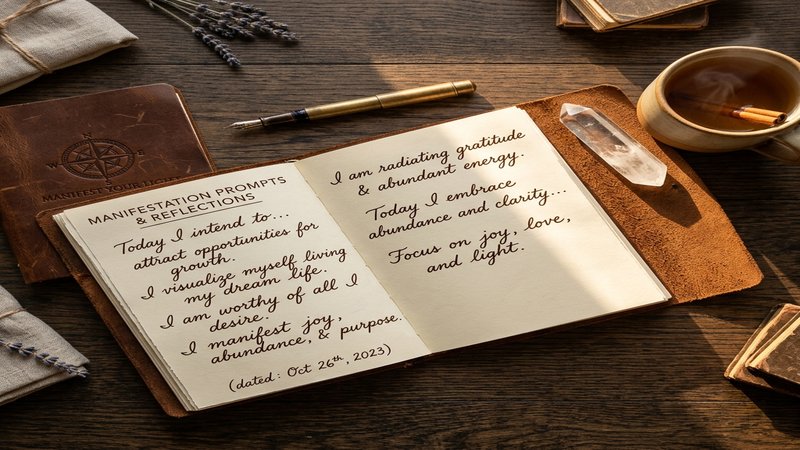
Manifestation journal prompts are questions designed to move you from vague wanting to specific knowing. Rather than writing that you want a better life, a prompt asks what better would actually look like on an ordinary Tuesday, which is a considerably harder question and a more useful one.
This collection contains fifty prompts across five areas: clarity, confidence, abundance, relationships and spiritual growth. It also covers a simple six-step routine, how manifestation journalling differs from scripting, whether to write in the present tense, and the mistakes that make the practice decorative.
One honest note. Writing does not produce external outcomes. What it reliably does is clarify what you want and surface what has been in the way, which changes the decisions you make afterwards. The decisions are what move things.
What Is a Manifestation Journal?
A manifestation journal is a notebook used specifically for intentions, reflection and the actions that follow, rather than for recording what happened.
The distinction from ordinary journalling is one of direction. A diary looks backwards at events. A manifestation journal looks at what you are moving towards and at what you are doing about it.
A typical entry contains three things:
- something you want, written specifically
- what you noticed since last time that relates to it
- one thing you will do before the next entry
That third element is what separates a working journal from a collection of wishes. Plenty of people keep beautiful journals full of intentions and nothing changes, and the missing piece is almost always the action line.
How Journalling Supports Intention Setting
Four mechanisms, none of them mystical.
It forces specificity. You can hold a vague want in your head indefinitely. You cannot write it into a full sentence without noticing how empty it is.
It surfaces resistance. Write down something you want and then write honestly about whether you believe it is possible. What comes out is usually the actual obstacle, and it is rarely what you assumed.
It creates a record. Reading entries from six months ago tells you what has moved, what has stalled and what quietly stopped mattering. None of that is visible from inside a single week.
It allocates attention. Ten minutes writing about what you want is ten minutes not spent rehearsing what you fear. That reallocation is the practical value.
What journalling does not do is cause events. If a prompt asks what you want and you write it down, nothing is thereby set in motion except your own clearer thinking, and that is enough to be worth the ten minutes.
10 Prompts for Clarity
- If nothing were expected of me, what would I actually want?
- What does an ordinary good Tuesday look like in the life I am building?
- What am I pursuing because I want it, and what because I am supposed to?
- What would I stop doing if I were being honest about what it costs me?
- What do I already know but have not admitted to myself?
- What have I been calling a goal that is really someone else’s expectation?
- If I had to describe what I want in one sentence, what would it be?
- What am I waiting for, and is it ever actually going to arrive?
- What would change if I decided this month rather than postponing again?
- What does enough look like for me, specifically?
10 Prompts for Confidence
- What have I done that I would be impressed by in someone else?
- Where do I underestimate myself, and what evidence contradicts it?
- What would I attempt if I knew I could handle it going badly?
- Whose voice is my inner critic, and what does it actually say?
- What am I better at now than I was two years ago?
- Where do I apologise for taking up space?
- What would I say yes to if I did not need to feel ready first?
- What have I survived that I rarely give myself credit for?
- Where am I waiting for permission that nobody is going to give?
- What would the version of me I am becoming do about this?
10 Prompts for Abundance
- What does abundance mean to me beyond money?
- What did my family teach me about money without saying it directly?
- What do I already have that I once actively worked for?
- Where am I avoiding looking at my finances, and why?
- What would financial stability let me stop worrying about?
- What do I believe about people who have significantly more than me?
- What skill would meaningfully increase what I am able to create?
- Where do I act from scarcity even when the situation does not call for it?
- What would I do with more, honestly, and does that tell me something?
- What is one financial habit I could start this month and keep?
10 Prompts for Relationships
- What do I want from my closest relationships that I have never said out loud?
- What am I bringing into my relationships that I have not examined?
- Which relationships genuinely sustain me, and which drain me?
- Where do I compromise more than I should?
- What boundary do I need to set, and what am I afraid would happen?
- How do I behave when someone gets close to me?
- What would I need in order to feel safe being fully honest with someone?
- Who have I been meaning to contact, and what is stopping me?
- What am I still carrying from a relationship that has ended?
- How do I want people to describe what it is like to know me?
10 Prompts for Spiritual Growth
- What is my practice actually asking of me right now?
- Where am I using spiritual language to avoid something practical?
- What would deepen my practice rather than expand it?
- What am I seeking through spiritual practice, honestly?
- When did I last feel genuinely still, and what made that possible?
- What have I learned that I have not yet put into practice?
- What am I grateful for that I usually walk past?
- Where do my values and my daily behaviour not match?
- What would I do differently if I trusted the process more?
- What do I want my inner life to feel like in a year?
How to Use These Prompts
A six-step routine, about fifteen minutes.
1. Settle your mind. Two minutes of slow breathing before you write. Writing while agitated produces venting rather than reflection.
2. Select one prompt. One, not five. Choose whichever you feel slight resistance to, since that usually indicates the useful one.
3. Write honestly. Ten minutes, continuously, without editing. Nobody is reading this. The moment you start writing for an imagined audience, the practice stops working.
4. Identify the emotion. Read it back and name what you felt while writing: fear, relief, irritation, sadness. The emotion often points more accurately than the content. Those drawn to reflective rather than analytical approaches may find our comparison of self-hypnosis and meditation useful for choosing what to pair this with.
5. Identify one practical action. Small and specific, doable before your next entry. This is the step people skip and the one that matters.
6. Review periodically. Once a month, read back through everything. Twenty minutes of review tells you more about whether anything is changing than any individual session does.
Manifestation Journalling vs Scripting
The two get used interchangeably. They are different practices.
| Manifestation Journalling | Scripting | |
|---|---|---|
| Format | Responses to prompts, exploratory | Continuous description of a desired situation |
| Tense | Usually present or future, varies freely | Present tense throughout, as if already true |
| Purpose | Clarity, self-examination, honesty | Emotional connection, motivation |
| Strength | Surfaces resistance and blind spots | Sustains enthusiasm over long stretches |
| Weakness | Can become analytical without action | Can drift into fantasy with no action attached |
| Frequency | Two or three times a week | Weekly is usually enough |
Neither is better. Journalling asks what is true, scripting describes what you want as though it were. Many people use scripting weekly for connection and prompt-based journalling more often for honesty, which is a sensible combination.
Should You Write in Present Tense?
The present tense is standard advice in manifestation writing, and it deserves qualifying.
Where it helps: with statements you can nearly believe. I am building a stable income through work I can improve at reads as immediate and creates no resistance.
Where it backfires: with statements you privately reject. I am wealthy written by someone whose account is empty tends to trigger the contradicting thought rather than the intended one, and the practice becomes a small argument with yourself.
A more workable approach is the becoming tense: I am learning, I am building, I am becoming. It is present, it is honest, and it points at something in motion.
For the prompts above, write however you naturally answer a question. Prompt responses are exploratory, and forcing them into present tense makes them stilted.
How Often Should You Journal?
Two or three times a week is the pattern that holds, rather than daily.
The reason is practical. Each entry ends with an action, and you need enough time between entries for that action to have happened. Daily journalling tends to produce the same reflections repeatedly, because nothing has changed since yesterday.
A workable rhythm:
- Two or three prompt entries weekly, fifteen minutes each
- One review monthly, twenty minutes, reading back through
- One longer session quarterly, revisiting the clarity prompts to see whether what you want has shifted
Keep it short enough to survive a busy fortnight. A practice that takes forty-five minutes will be abandoned.
Common Manifestation Journal Mistakes
Writing instead of acting. The defining failure. A full journal and an unchanged life means the action step is missing.
Writing what you think you should want. The prompts only work if the answers are honest, and honesty requires knowing nobody will read it.
Using too many prompts at once. One properly beats five superficially.
Changing intentions constantly. Give something several months. Rewriting your goals weekly guarantees nothing accumulates.
Never reviewing. Entries you do not read back are a record nobody consults. The monthly review is where the value compounds.
Making it performative. Journals styled for photographing are decorative objects. That is fine, but it is not this practice.
Expecting the writing to do the work. Clarity is the output. Action is yours.
Treating it as therapy. If prompts consistently surface distress you cannot move through, that deserves a qualified professional rather than another notebook.
The confidence prompts in particular tend to surface material about how you carry yourself in rooms and conversations, which is a practice in its own right and one we cover in our guide to developing personal presence.
Frequently Asked Questions
What are manifestation journal prompts?
Questions designed to move you from vague wanting to specific knowing, covering areas such as clarity, confidence, abundance, relationships and spiritual growth. Rather than writing that you want something better, a prompt asks what better would actually look like day to day, which is harder and more useful.
How do I start a manifestation journal?
Get a notebook you will actually use, settle for two minutes before writing, choose one prompt, and write honestly for ten minutes without editing. Then name the emotion that came up and identify one small action before your next entry. Review everything once a month.
Does manifestation journalling actually work?
It works as a clarity and attention practice. Writing forces specificity, surfaces resistance, creates a record you can review and directs attention towards what you want rather than what you fear. It does not cause external events. The decisions and actions that follow are what change anything.
How often should I write in a manifestation journal?
Two or three times a week works better than daily, because each entry should end with an action and you need time between entries for that action to happen. Add a monthly review of twenty minutes, which is where most of the value actually accumulates.
Should manifestation journalling be in present tense?
For affirmation-style statements, present tense works when you can nearly believe them, and backfires when you cannot. The becoming tense, such as I am learning or I am building, is often the better compromise. For prompt responses, write however you naturally answer a question.
What is the difference between manifestation journalling and scripting?
Journalling answers prompts and asks what is true, which surfaces resistance and blind spots. Scripting describes a desired situation in the present tense as though already real, which sustains motivation. They serve different purposes, and many people use both at different frequencies.
What should I write in a manifestation journal?
Something you want written specifically, what you have noticed since your last entry that relates to it, and one action you will take before the next. The prompts give you the first part. The second and third are what make the journal a working document rather than a wish list.
Bringing It Together
Manifestation journal prompts earn their place by making you answer questions you would otherwise leave comfortably vague. What does enough look like. Whose expectation am I carrying. What am I waiting for that is not coming.
Pick one prompt, write for ten minutes honestly, name what you felt, and choose one small action. Do that a few times a week and review monthly. The clarity accumulates, and the actions are what turn it into anything.
At The Golden Lotus, we treat reflective practice as a support for awareness and conscious action rather than as a method for producing outcomes. If the subconscious and self-reflective side of this interests you, our writing on the subconscious mind and self-hypnosis and on working with patterns before sleep goes further, and our structured programmes are there when you want guidance rather than solitary practice.

Have Questions About This Practice?
Whether you want to learn Reiki, explore Mesmerism, or book a 1-on-1 private energy alignment session, we welcome your questions.