
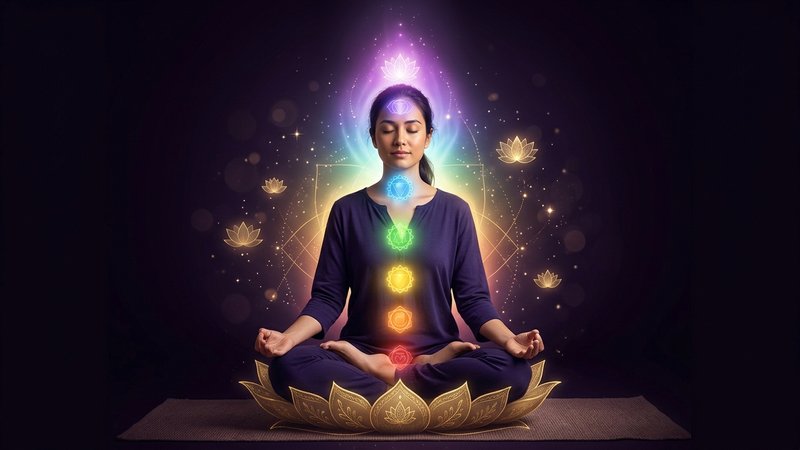
Chakra meditation is a practice in which attention is moved deliberately through the seven energy centres described in yogic tradition, usually from the base of the spine to the crown of the head, resting at each for a few breaths.
For beginners it is one of the more approachable forms of meditation, because it gives the mind a clear path to follow rather than asking it to sit in open awareness from day one.
This guide gives you a complete beginner routine, a section on each of the seven centres, breathing and visualization techniques, affirmations, and honest guidance on how long and how often to practise.
One clear boundary first. Chakra meditation is a spiritual and relaxation practice. It does not repair organs, treat illness or cure disease, and no responsible teacher will tell you otherwise. What regular meditation can reasonably support is attention, steadiness and self-awareness, which is worth a great deal on its own.
What Is Chakra Meditation?
Chakra meditation combines two simple elements: a focus point in the body and an object of attention such as breath, colour, sound or a short phrase.
You begin at the root, hold attention there for several breaths, then move upward through the sacral, solar plexus, heart, throat, third eye and crown. The sequence gives structure, and the structure is what makes it workable for people who find open meditation difficult.
Compared with other approaches, breath meditation keeps attention on one thing throughout and a body scan moves through physical regions. Chakra meditation moves through symbolic centres, each carrying a theme as well as a location.
That last point is the distinctive part. You are not only noticing sensation. You are sitting with a theme: safety at the root, expression at the throat, stillness at the crown.
If the seven centres are unfamiliar to you, our overview of the chakra system and its origins gives the background this practice assumes.
What Chakra Balancing Means Spiritually
Balance here does not mean a finished state. Nobody arrives at permanently balanced chakras and stops.
In traditional understanding, balancing means attention moving freely through the centres rather than catching at one. The practical version most practitioners recognise: you are less stuck, and the theme that had been dominating loosens enough for the others to be felt.
It also does not mean equal attention at each centre. Most people find one or two asking for more time, which is normal. The sequence is a route, not a quota.
What balancing is not: a diagnosis, a measurable state, or something a practitioner can verify.
Preparation Before Meditation
Five minutes of preparation improves the practice more than five extra minutes of sitting.
- Choose a consistent time. Early morning or before sleep both work well.
- Sit rather than lie down, at least at first. Lying down usually ends in sleep.
- Support your posture. A cushion under the hips, back supported if needed, or discomfort will dominate your attention.
- Remove interruptions. Phone on silent and face down, door closed.
- Set a gentle timer for ten to fifteen minutes, so you are not checking the clock.
- Take three slow breaths before starting, with a longer exhale than inhale.
If evening practice suits you but you tend to drift, some people find guided approaches easier at first. Our comparison of meditative and self-hypnosis approaches explains how the two differ and who each tends to suit.
The Beginner Seven-Chakra Meditation
Here is the complete routine. It takes ten to fifteen minutes depending on how long you rest at each centre.
- Settle (2 minutes). Sit comfortably, close your eyes, and breathe naturally. Let the body arrive before you start moving attention.
- Root (5 breaths). Bring attention to the base of the spine. Feel your contact with the seat and the floor. Theme: I am here, and I am safe enough in this moment.
- Sacral (5 breaths). Move attention below the navel. Let the breath feel soft and unforced. Theme: I allow myself to feel what I feel.
- Solar plexus (5 breaths). Attention above the navel. Notice the slight expansion with each inhale. Theme: I can act on my own behalf.
- Heart (5 breaths). Attention at the centre of the chest. Let the breath widen there. Theme: I can give and receive warmth.
- Throat (5 breaths). Attention at the throat. Notice how the breath passes through. Theme: I can say what is true for me.
- Third eye (5 breaths). Attention between the eyebrows, held lightly rather than pressed. Theme: I see this clearly.
- Crown (5 breaths). Attention at the top of the head, or slightly above it. Nothing to do here. Theme: stillness.
- Return and close (2 minutes). Let attention drop back down to the base, feel the whole body at once, then open your eyes slowly.
Always finish by returning to the root. Ending at the crown leaves many people feeling scattered, and a minute of grounding makes the difference between a practice that steadies you and one that floats.
Root Chakra Meditation
Focus: base of the spine. Colour: red. Sound: LAM. Theme: safety, belonging, ground.
Rest attention where your body meets the seat. If visualization helps, picture a deep red at the base of the spine, or imagine the body settling downward.
Spend extra time here when you feel restless or unable to settle. Practitioners often suggest doubling the time at the root for the first week of any chakra practice, because the centres above it work better from a settled base.
Sacral Chakra Meditation
Focus: below the navel. Colour: orange. Sound: VAM. Theme: feeling, creativity, flow.
Let the breath become soft here. The element is water, so the imagery is movement rather than holding.
Useful when emotions feel flat or creative work has stalled. Keep it light, since this centre responds better to ease than to effort.
Solar Plexus Meditation
Focus: above the navel. Colour: yellow. Sound: RAM. Theme: will, confidence, direction.
Notice the natural expansion of the abdomen with each inhale, fuller than usual without forcing.
Useful before a difficult conversation or a decision you have been avoiding. The traditional aim is warmth, not heat, so soften the breath if tension gathers.
Heart Chakra Meditation
Focus: centre of the chest. Colour: green, sometimes pink. Sound: YAM. Theme: compassion, connection, forgiveness.
Let the breath widen across the chest rather than only rising and falling.
A common addition here: bring one person to mind whom you feel warmth towards, hold that for a few breaths, then extend the same quality towards yourself. Many people find the second part noticeably harder, which is information worth noticing rather than judging.
Throat Chakra Meditation
Focus: throat. Colour: blue. Sound: HAM. Theme: expression, truth, listening.
Notice the passage of breath through the throat, and let the jaw and tongue release.
This centre responds particularly well to voice. If you are somewhere private, humming for a minute before settling into silence makes a noticeable difference. Chanting and mantra are the traditional practices associated with it.
Third Eye Meditation
Focus: between the eyebrows. Colour: indigo. Sound: OM. Theme: clarity, insight, perception.
Hold attention lightly here. Straining the eyes upward is the most common beginner error and often produces a headache.
If you find third eye focus unsettling, and some people do, shorten your time here and lengthen your time at the root. Traditional sequencing begins at the base for exactly this reason.
Crown Chakra Meditation
Focus: top of the head. Colour: violet or white. Sound: silence. Theme: stillness, awareness.
There is nothing to do at the crown, and that is the practice. No visualization is required, no effort applied. Let attention rest and allow the mind to be quiet.
If quiet is uncomfortable, which is common at first, simply return to counting breaths. The discomfort is worth staying with over time.
A Suggested Breathing Pattern
Keep it simple, especially at first.
For general practice, breathe naturally through the nose with the exhale slightly longer than the inhale, and do not count unless counting helps. If your mind wanders constantly, try a four-count inhale and a six-count exhale, since the longer exhale tends to settle agitation. At each centre, five breaths is a good default, extended to eight or ten where a centre seems to want more.
Avoid forceful breathing techniques, extended breath retention or rapid breathing in a beginner chakra practice. Those belong with a qualified teacher, and they are not suitable during pregnancy or for anyone with heart conditions, high blood pressure, epilepsy or certain respiratory conditions.
Visualization Techniques
Four approaches, in increasing order of difficulty. Use whichever works and ignore the rest.
- Colour. Picture the associated colour at each centre. The most common method and easiest to learn.
- Light. Imagine a soft light moving upward along the spine, pausing at each centre.
- Sensation. Skip imagery and simply notice physical sensation at each location. This suits the many people who do not visualise easily.
- Form. Traditional practices work with the geometric forms and seed syllables of each centre. Deeper work, best learned with a teacher.
If you cannot picture anything at all, you are not doing it wrong. Attention to the location is the practice. Imagery is an optional aid.
Using Affirmations
A short phrase at each centre gives the mind something to hold. Keep them believable. A statement you privately disagree with tends to invite the opposite thought.
- Root: I am here, and I am steady.
- Sacral: I allow myself to feel and to create.
- Solar plexus: I can act on my own behalf.
- Heart: I can give warmth and receive it.
- Throat: I say what is true for me.
- Third eye: I see this situation clearly.
- Crown: I am willing to be still.
Say them silently, once, without repetition or emphasis. Chakra meditation is not an affirmation session, and long lists distract from the attention that does the work.
Using Crystals or a Chakra Bracelet
Symbolic aids are entirely optional. Nothing in this practice requires them.
People use them in three ways: a single stone held in the hand throughout, stones placed at each centre during a longer lying-down practice, or a seven-stone bracelet worn as a tactile guide with one bead per centre.
The bead-by-bead method suits beginners, because the hand has something to do and the sequence becomes physical rather than remembered.
Be clear about the role. Stones focus attention and mark intention. They do not act on the body, and the practice works perfectly well without them.
How Long Should You Meditate?
For beginners, ten to fifteen minutes is the useful range. That allows roughly five breaths at each centre with time to settle and close.
As practice develops, a seven-minute version with three breaths per centre covers busy days, ten to fifteen minutes remains the standard, and an extended sitting of twenty-five to thirty minutes works best by resting longer at two or three centres rather than adding time everywhere.
Longer is not automatically better. A distracted thirty minutes is worth less than an attentive ten.
How Often Should You Practise?
Daily, if you can, even briefly. The benefit of meditation comes from regularity rather than duration, and a short daily sit outperforms a long weekly one consistently.
A workable pattern: ten minutes daily for the first two weeks with extra time at the root, the full sequence at an even pace in weeks three and four, then daily practice ongoing with a longer session once a week if you enjoy it.
Missing a day is not a failure. Restart the next day without ceremony. The people who sustain a practice over years are the ones who treat gaps as ordinary.
Common Mistakes
Expecting to feel something dramatic. Most sessions feel unremarkable. That is what the practice mostly feels like, and it still works.
Straining at the third eye. Physically tensing the eyes upward causes headaches. Hold attention lightly.
Skipping the grounding close. Finishing at the crown leaves many people scattered. Always return to the root.
Trying to force balance. Noticing that a centre feels stuck is the practice. Wrestling with it is not.
Practising while exhausted. You will fall asleep. Choose a time when you are reasonably alert, and judge a session by whether you sat rather than by how it felt.
Treating it as treatment. If something is persistently wrong physically or emotionally, see a doctor. Meditation sits alongside proper care, never in place of it.
The relationship between physical state, attention and inner steadiness runs in both directions, which we explore further in our writing on integrated mind and body practice.
Frequently Asked Questions
How do I do chakra meditation as a beginner?
Sit comfortably, settle for two minutes, then move attention through the seven centres from the base of the spine to the crown, resting about five breaths at each. Use a colour or a short phrase at each if it helps. Close by returning attention to the root and grounding for a minute.
How long should a chakra meditation be?
Ten to fifteen minutes suits most beginners, which allows around five breaths at each centre plus time to settle and close. Shorter sessions of seven minutes work well on busy days. Consistency matters more than length, so a daily ten minutes generally serves better than a weekly hour.
What is the correct order for the seven chakras in meditation?
Root to crown is the standard sequence: base of the spine, below the navel, above the navel, centre of the chest, throat, between the eyebrows, and the top of the head. Some practices descend from crown to root afterwards. Whichever direction you use, finish by grounding at the root.
Can chakra meditation heal physical illness?
No. Chakra meditation is a spiritual and relaxation practice, not a medical treatment. It does not repair organs, cure disease or replace medical care. Regular meditation can reasonably support attention, calm and self-awareness, and it should be treated as a complement to proper healthcare rather than a substitute.
Do I need crystals for chakra meditation?
No. Crystals and chakra bracelets are optional symbolic aids that give attention something to rest on. The practice works fully without them. If you like using them, a bead-per-centre bracelet is a helpful way to keep the sequence physical, particularly while you are still learning the order.
What should I feel during chakra meditation?
Usually very little, and that is normal. Some people notice warmth, tingling or a sense of ease at particular centres, and others notice nothing at all. Neither indicates success or failure. The practice is the attention you give it, not the sensations it happens to produce.
Why do I feel restless or emotional after meditating?
Sitting quietly often brings feelings to the surface that activity keeps at bay, and mild restlessness is common early on. Grounding properly at the end usually helps. If meditation consistently leaves you distressed, or brings up difficult memories, pause the practice and speak to a qualified professional.
Bringing It Together
Chakra meditation gives beginners something most meditation does not: a clear path to follow. Start at the base, move up, rest at each centre, and come back down to ground.
Keep the sessions short enough to repeat daily, hold your expectations modest, and pay more attention to whether you showed up than to how any single sitting felt.
At The Golden Lotus, this practice sits at the foundation of the energy work we teach. If you would like to be guided through it rather than working alone at first, our chakra balancing consultation offers a structured introduction with a practitioner, and you are welcome to ask what a session involves before booking.
Have Questions About This Practice?
Whether you want to learn Reiki, explore Mesmerism, or book a 1-on-1 private energy alignment session, we welcome your questions.