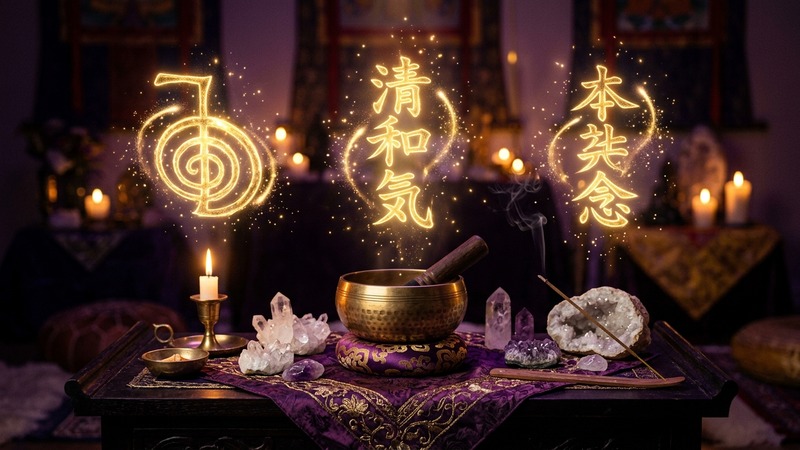
Reiki symbols are among the most talked-about—and most misunderstood—parts of Reiki. Some people believe the symbols themselves hold power; others see them as simple focusing tools. In most modern Reiki teaching, they are understood as keys for intention: each symbol helps the practitioner focus Reiki energy for a particular purpose.
This beginner’s guide explains the five Reiki symbols most commonly taught in Usui-based lineages, what they mean and how practitioners use them.
Where Do Reiki Symbols Come From?
Reiki was founded by Mikao Usui in Japan in the early 1920s. The symbols taught today are associated with his system, though historians note that the way they are used has changed as Reiki travelled from Japan to the West through teachers such as Chujiro Hayashi and Hawayo Takata. Some symbols are based on Japanese kanji, and each has a name that doubles as a mantra, usually repeated three times when the symbol is used.
When Are Reiki Symbols Taught?
- Level 1: No symbols. Students learn hands-on self-Reiki and treating others.
- Level 2: The first three symbols—power, mental/emotional and distance.
- Level 3 / Master: The master symbol, and in many lineages, the Raku symbol used in attunements.

The Five Reiki Symbols Explained
1. Cho Ku Rei — The Power Symbol
Cho Ku Rei is often described as the “power switch” of Reiki. Its name is commonly interpreted as “place the power here” or “focus the energy here.”
Common uses: increasing the flow of Reiki at the start of a session, focusing energy on a specific area, sealing and closing a session, and energetically clearing a room.
2. Sei He Ki — The Mental and Emotional Symbol
Sei He Ki is associated with harmony between the mind and emotions. Translations vary, but practitioners broadly connect it with emotional balance, calm and the subconscious mind.
Common uses: supporting emotional release, working with unwanted habits or thought patterns, and bringing calm during stressful times.
3. Hon Sha Ze Sho Nen — The Distance Symbol
Hon Sha Ze Sho Nen is the symbol used for distance Reiki. It is often interpreted as “no past, no present, no future,” pointing to the idea that Reiki is not limited by time or space.
Common uses: sending Reiki to a person in another place, sending Reiki to past or future situations, and connecting with a receiver during remote sessions.
4. Dai Ko Myo — The Master Symbol
Dai Ko Myo is usually translated as “great bright light” or “great shining light.” It is associated with spiritual insight and the deepest level of Reiki practice.
Common uses: attunements, deep spiritual work, and strengthening the practitioner’s personal practice. It is typically taught at master level.
5. Raku — The Completion Symbol
Raku, sometimes called the fire serpent or lightning bolt, is used in many Western Usui/Tibetan lineages to complete attunements and to ground energy.
Common uses: completing attunements and grounding energy after a session.
Usui Reiki Symbols and Meanings: Quick Reference
| Symbol | Common name | Associated meaning | Usually taught at |
|---|---|---|---|
| Cho Ku Rei |
Power symbol | Focus and increase energy | Level 2 |
| Sei He Ki | Mental/emotional symbol | Emotional and mental harmony | Level 2 |
| Hon Sha Ze Sho Nen | Distance symbol | Connection beyond time and space | Level 2 |
| Dai Ko Myo | Master symbol | Great bright light; spiritual insight | Master level |
| Raku | Completion symbol | Grounding and completing attunements | Master level |
How Practitioners Use Reiki Symbols
Practitioners activate symbols in several ways:
- drawing them in the air with the palm or fingers;
- visualising them over the receiver or an area of the body;
- drawing them on their own palms before a session;
- silently repeating the symbol’s name three times.
What matters most is steady intention and correct instruction from a qualified teacher.
From Hardik’s practice: In our Level 2 and Level 3 trainings, students quickly realize that symbols are not mystical talismans in themselves—they are sacred tuning forks that focus the practitioner’s pure intention and anchor specific energetic frequencies.
Learn the Reiki Symbols Properly
Symbols are best learned with a teacher who can explain their use and give the corresponding attunement. Begin with the Reiki Level 1 & 2 Course, study Reiki symbols and crystals in the Reiki Level 3 Course, and receive master-level teachings in the Reiki Master Teacher Course (Level 4–5).
Frequently Asked Questions
How many Reiki symbols are there?
Traditional Usui Reiki uses four symbols. Many Western lineages add Raku, making five.
Can I use Reiki symbols without an attunement?
Most Reiki teachers say the symbols are activated for a student through the Level 2 and master attunements, so they recommend learning them through proper training.
Are Reiki symbols religious?
Reiki is not a religion. Although some symbols draw on Japanese characters and Buddhist concepts, people from all faiths practise Reiki.
Disclaimer: Reiki and related spiritual practices are complementary practices. They are not a substitute for medical diagnosis, treatment or mental-health care.
Have Questions About This Practice?
Whether you want to learn Reiki, explore Mesmerism, or book a 1-on-1 private energy alignment session, we welcome your questions.