
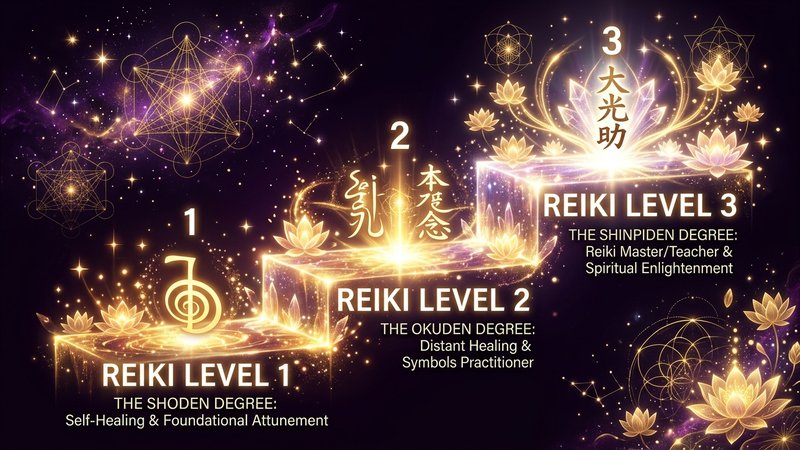
Reiki Level 1 teaches you to treat yourself. Level 2 adds the traditional symbols and distance practice, opening the work to others. Level 3 is the Master level, where the emphasis shifts from technique towards depth of personal practice.
Each level begins with an attunement from a teacher, and each is followed by a period of daily practice before moving to the next. The gap between them is not administrative. It is where the actual development happens.
This guide sets out what changes at each stage, how the levels compare side by side, how long to wait between them, and how to tell whether you are genuinely ready to progress.
One caveat worth stating early. Reiki lineages do not all structure their levels identically. The pattern described here reflects the common Western structure, which most course descriptions follow. Japanese traditional schools and some modern systems organise things differently, so always check a specific school’s syllabus rather than assuming.
Reiki Training Levels Explained
Reiki is taught in stages, each marked by an attunement in which a teacher transmits at that level to a student. In Japanese traditional terms the stages are called Shoden, Okuden and Shinpiden, meaning first, inner and mystery teachings.
What changes between levels is not the energy but your relationship to the practice:
- Level 1 turns attention inward, to your own hands and your own body.
- Level 2 turns it outward, to others and beyond physical proximity.
- Level 3 turns it back inward, but at a different depth.
That shape, in and out and in again, is the part beginners rarely anticipate and experienced practitioners usually recognise.
If the concept of attunement is new to you, our article on what happens during a Reiki attunement covers the ceremony and the settling period that follows.
Reiki Level 1 Overview
Japanese name: Shoden. Focus: yourself. Symbols: none, in most lineages.
Reiki Level 1 is the entry point and requires no previous experience. Typical content includes the first attunement, the history and lineage of Usui Reiki, the five precepts known as the Gokai, the hand positions for self-treatment, and guidance on establishing a daily practice.
Students usually also begin treating family and friends informally, though the emphasis remains firmly on self-practice.
Courses commonly run over one or two days. The teaching is the short part. What makes Level 1 work is the daily practice afterwards.
Typical Focus of Level 1
Three things are actually being built at this stage, and none of them is technique.
Sensitivity. Most beginners feel very little at first. Over weeks of daily practice, awareness of warmth, subtle sensation or simply a settled quality begins to develop. This cannot be rushed and is the main reason teachers ask for a practice period before Level 2.
Habit. A practitioner is someone who practises. Level 1 is where that habit is either formed or not, and the students who never establish it rarely progress regardless of how many levels they take.
Relationship with the precepts. The Gokai are deceptively simple lines about anger, worry, gratitude, honest work and kindness. They are the ethical spine of the practice, and they reward years of attention.
For readers unfamiliar with the foundations, our introduction to Usui Reiki covers the history and principles this level assumes.
Reiki Level 2 Overview
Japanese name: Okuden. Focus: others, and distance. Symbols: three traditional symbols.
Level 2 is the largest single expansion in the path. Content typically includes the second attunement, the three traditional symbols and their uses, distance practice with the etiquette of consent that accompanies it, more structured sessions for others, and deeper work with the precepts.
This is the level at which most practitioners begin working with people outside their own household, and the level most people mean when they say they practise Reiki.
Many schools teach Levels 1 and 2 together in a single course, which works well provided the practice period between the two attunements is respected rather than compressed. Our Level 1 and 2 training is structured in that sequence.
Introduction to Symbols and Distance Practice
The three symbols given at Level 2 are traditionally associated with focusing energy, with mental and emotional harmony, and with distance work. Their names are widely published, and we cover their meanings and traditional uses in our guide to the Reiki symbols and what they represent.
What is not published, by us or by most traditional schools, is the drawn form, stroke sequence or activation method. Those are given during attunement, because Reiki treats the symbols as transmitted rather than copied.
Distance practice is the other major addition. It allows a practitioner to work with someone who is not physically present, and it brings a responsibility with it: traditional etiquette requires the recipient’s permission first. Sending Reiki to someone unasked, however kindly meant, overrides their choice.
A common beginner pattern at this level is symbol enthusiasm, using all three in every session. Experienced practitioners tend to use fewer and pay more attention. That restraint is part of what Level 3 develops.
Reiki Level 3 Overview
Japanese name: Shinpiden, in traditions that use the term. Focus: depth. Symbols: the Master symbol.
Level 3 is where lineages diverge most, so course descriptions deserve careful reading.
Commonly included:
- the Master attunement
- the Master symbol, Dai Ko Myo
- extended meditation and deepened personal practice
- in some schools, crystal work and additional techniques
- a shift in emphasis from doing towards presence
The change most practitioners describe is one of quality rather than content. Sessions become quieter. There is less reaching for technique and more simply being present, which sounds vague until you have experienced the difference.
Our Level 3 course covers Master symbol work alongside crystals as part of personal practice.
Master-Level Practice
An important distinction that causes regular confusion: receiving the Master attunement does not by itself make someone a teacher.
In many schools, including ours, the path separates into two:
- Master practitioner: works at Master level in their own practice and with clients, but does not attune others
- Master teacher: additionally trained to run courses and perform attunements for students
Teaching requires its own training. Performing an attunement, structuring a course, handling student questions and taking responsibility for someone else’s practice are separate skills from personal proficiency.
There is no hierarchy of worth here. Many excellent practitioners never teach and have no wish to, and that is a complete path in itself.
Level 1 vs Level 2 vs Level 3: Comparison Table
| Level | Main Focus | Typical Practices | Symbols | Suitable For |
|---|---|---|---|---|
| Level 1 (Shoden) | Self-treatment and foundation | Daily self-practice, hand positions, the Gokai | None in most lineages | Complete beginners, no experience needed |
| Level 2 (Okuden) | Treating others and distance work | Structured sessions, distance practice, symbol work | Three traditional symbols | Those with an established Level 1 practice, usually after several weeks or more |
| Level 3 (Shinpiden) | Depth of personal practice | Extended meditation, Master symbol work, in some schools crystals | Master symbol | Committed practitioners, usually after six months to a year at Level 2 |
| Master and Teacher | Teaching and attuning others | Performing attunements, course delivery, mentoring students | All, plus attunement practice | Those who genuinely want to teach, usually after a year or more at Master level |
Attunement Differences
Each level involves its own attunement, and the ceremony differs between them in ways that depend on lineage.
What is broadly consistent:
- each attunement corresponds to the level being entered
- the ceremony itself is short, usually quiet, and often unremarkable to watch
- experiences vary widely. Some students report warmth, colour or emotion, many feel nothing, and feeling nothing does not indicate failure
- a settling period follows, commonly described as around three weeks, during which daily practice is encouraged
Students sometimes expect each successive attunement to feel more dramatic than the last. In practice it often works the other way, with later attunements feeling quieter as the practitioner becomes more settled.
Practice Expectations Between Levels
Expectations vary by school, but a reasonable pattern looks like this.
After Level 1: daily self-treatment, twenty to thirty minutes where possible, ten minutes on difficult days. Treating a few family members or friends. At least three weeks before Level 2, and longer is better.
After Level 2: continued daily self-practice, plus regular sessions for others. Beginning distance practice with consent. Six months to a year before Level 3.
After Level 3: daily practice with a meditative emphasis. A year or more before teacher training, if that path appeals.
A teacher who sets no expectations between levels is worth questioning. So is one who encourages you to move up quickly. Both usually indicate a school oriented towards certificates rather than practice.
How Long Should You Wait Between Levels?
There is no universal rule, and lineages differ. What is broadly agreed is that the waiting is part of the training rather than a delay before it.
Common guidance:
- Level 1 to Level 2: a minimum of three weeks, often longer. Some schools teach them together with a practice interval built in.
- Level 2 to Level 3: six months to a year is typical.
- Level 3 to teacher training: at least a year, frequently more.
The practical reason is straightforward. Each level adds tools, and tools are only useful to someone who has developed enough sensitivity to know when to use them. Rushing produces practitioners with a full toolkit and very little judgement.
Who Should Progress to the Next Level?
Useful questions to ask yourself, in order.
Am I practising daily? If not, the next level will not fix that. It is the single most reliable indicator.
Am I comfortable with what I already have? Level 1 hand positions should feel familiar rather than effortful before Level 2 makes sense.
Why do I want to progress? Curiosity and readiness are good reasons. Boredom, wanting a more impressive certificate, or feeling stuck are usually signs to stay and practise.
Have I actually used what I learned? Someone who took Level 2 and never gave a distance session is not ready for Level 3, whatever the calendar says.
What does my teacher say? A good teacher will tell you honestly, and their answer is worth more than your own enthusiasm.
There is no requirement to progress at all. Many people practise happily at Level 1 or 2 for years, and a settled Level 1 practice is worth more than an unused Master certificate.
Master and Teacher Training
If teaching appeals, this stage covers what Master-level practice does not automatically provide:
- how to perform attunements for students
- how to structure and deliver a course
- ethics, consent, boundaries and student responsibility
- your responsibility for the lineage you pass on
- handling difficult sessions, emotional responses and questions outside your scope
Two questions worth answering honestly before committing. Do you actually want to teach, or do you want the title? And are you prepared to be responsible for other people’s practice, including when they get things wrong?
Our Master and Teacher training is intended for practitioners who have worked at Master level for a meaningful period and want to carry the lineage forward.
Frequently Asked Questions
What is the difference between Reiki Level 1 and Level 2?
Level 1 focuses on self-treatment, hand positions and the precepts, and teaches no symbols in most lineages. Level 2 introduces three traditional symbols and distance practice, opening the work to treating others more formally. Level 1 turns attention inward, Level 2 turns it outward.
What do you learn in Reiki Level 3?
Level 3 is the Master level. It typically includes the Master attunement, the Master symbol Dai Ko Myo, extended meditation and deepened personal practice, and in some schools crystal work. The emphasis shifts from technique towards presence. Receiving Master attunement is not the same as being trained to teach.
How long should you wait between Reiki levels?
Commonly at least three weeks between Levels 1 and 2, six months to a year between Levels 2 and 3, and a year or more before teacher training. The waiting period is part of the training rather than a delay, since each level adds tools that require developed judgement to use well.
Do you need Level 2 to practise Reiki on others?
Not strictly, since Level 1 practitioners often treat family and friends informally. Level 2 is where structured treatment of others and distance practice are formally taught, and most practitioners who work with people beyond their own circle hold at least Level 2.
Is Reiki Level 3 the same as Reiki Master?
In most Western schools, Level 3 is the Master level, but schools differ on whether it includes teacher training. Some split it into a Master practitioner stage and a separate teacher stage, others combine them. Always check what a particular course includes before assuming it qualifies you to teach.
Which Reiki level should I start with?
Level 1, always. It requires no experience and establishes the self-practice everything else rests on. Many schools teach Levels 1 and 2 together, which works well when the practice interval between the two attunements is respected rather than skipped.
Do all Reiki lineages use the same level structure?
No. The three-levels-plus-teacher structure is common in Western schools, but Japanese traditional lineages and some modern systems organise things differently, including how Master and Teacher stages are divided. Check a specific school’s syllabus rather than assuming a universal system applies.
Bringing It Together
The levels of Reiki are less a ladder than a sequence of doors, each opening onto a period of practice rather than a new set of abilities. Level 1 builds the habit, Level 2 extends the reach, Level 3 deepens the quality, and teacher training adds responsibility for others.
The most reliable sign of a practitioner is not which level they hold. It is whether they practised this morning.
At The Golden Lotus, we teach each stage in its traditional sequence and are candid about which one suits a given student. If you are unsure where you belong on this path, tell us about your practice and we will point you to the right level rather than the next one.

Have Questions About This Practice?
Whether you want to learn Reiki, explore Mesmerism, or book a 1-on-1 private energy alignment session, we welcome your questions.